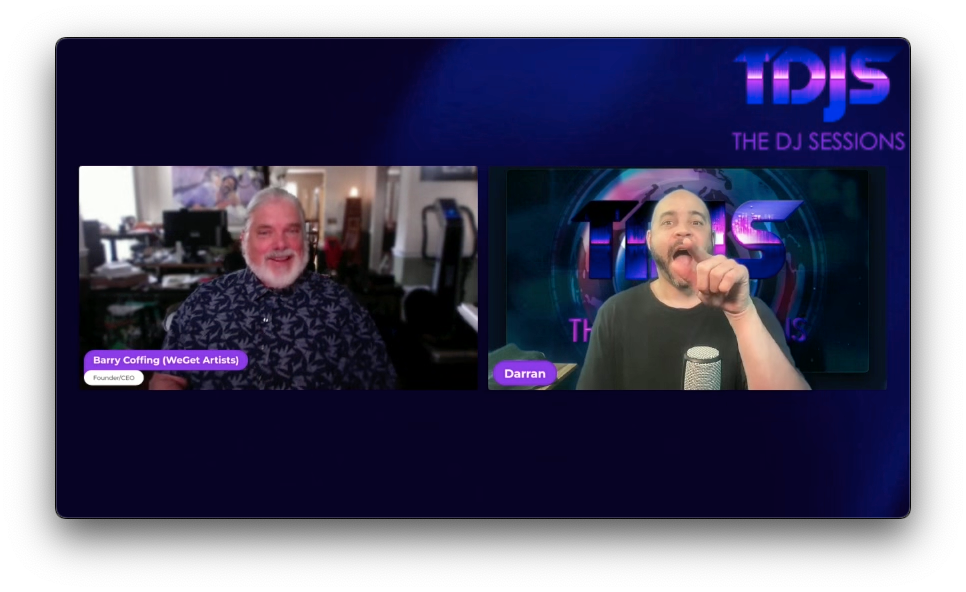
Barry Coffing – Music Licensing, Film Strategy, and Building Sustainable Artists on the Virtual Sessions 2/12/26
Shownotes
Broadcasting from Houston, Texas, Barry Coffing joins for a deep dive into the realities of music licensing, supervision, and artist development. With decades of experience as a songwriter, producer, performer, and founder of musicsupervisor.com and We Get Artists, Barry breaks down how he built a global licensing platform that now houses hundreds of thousands of tracks and services major film studios and television networks.
He shares the origin story of creating a searchable music database after struggling to find songs for indie films, eventually raising funding to build a powerful search engine that allows supervisors to pinpoint highly specific musical needs in seconds. Along the way, he explains why “good” songs often place more than “great” ones, how music must enhance a scene without distracting from dialogue, and why emotional universality in lyrics increases placement potential.
Barry pulls back the curtain on sync realities, from replacing major artists last minute on film soundtracks to navigating soundtrack buyouts, agency politics, and the importance of instrumental and alternate mixes. He emphasizes that success in sync is less about selling and more about solving creative problems quickly and professionally.
Beyond licensing, Barry highlights Sustainable Artists and Springboard Fest, where emerging talent receives mentorship from industry veterans and performance coaches. His message to artists is clear – increase your catalog, protect your rights, build your social presence, and treat every track like a lottery ticket with multiple pathways to win.
Topics
0:11 – Introduction and Barry’s background in Houston
1:20 – Building musicsupervisor.com from indie film challenges
5:55 – Cataloging, quality control, and search engine precision
9:52 – Why supervisors return to deep and diverse catalogs
14:20 – Why good songs place more than great ones
18:23 – How songs lose placements at the last minute
25:11 – Common sync misconceptions from independent artists
28:19 – Deliverables and what sync ready really means
39:03 – AI music risks and copyright realities
1:01:18 – We Get Artists and Springboard Fest opportunities
Connect with Barry Coffing
We Get Artists: wegetartists.com
Music Supervisor: musicsupervisor.com
Springboard Fest: springboardfest.com
Discover more interviews and exclusive content at thedjsessions.com
About Barry Coffing –
BARRY COFFING is a music business entrepreneur, sought-after speaker, and moderator. His music licensing company Music Supervisor Inc. represents over 20,000 labels, libraries, and music artists for film and TV licensing. Nearly every major film company and TV network uses his software. and as a result, a track they represent is licensed every 72 hours.
EXPERIENCE Barry has been an artist (WB Records), songwriter, composer, producer, engineer, music supervisor, and label owner (Sony RED distribution). His music publishing company is administered by the Universal Music Group. He has toured the world as a music director for other artists, as well as writing and producing music for Films, TV, Jingles, and Ad Agencies. As a singer, his voice can be heard singing the end title songs for The Brady Bunch Movie, and Pooh’s Grand Adventure.
PAST AND CURRENT MUSIC LICENSING CLIENTS Sony, Disney, Paramount, Warner Brothers, Universal, DreamWorks, Lionsgate, MGM, United Artists, NBC, CBS, ABC, Fox, CW, AMC, HBO, Netflix, Hulu, Apple, Amazon, Showtime, Lifetime, General Mills, US Army, Volkswagen.
MUSIC PRODUCTION CLIENTS: Michael McDonald, Chaka Khan, Peabo Bryson, Thelma Houston, Irene Cara, Tiffany, Lee Greenwood, Gary Puckett, and many others.
EDUCATION: Graduated from the High School for the Performing and Visual Arts in Houston, Texas (Vocal Music Major), after which he received an opera scholarship from Houston Baptist University. He also attended the University of Houston, majoring in Radio & TV Performance.
RECOGNITION: In his 30+ years in the music business, he amassed a great deal of credits and awards. He has placed over 200 of his own songs in films and television, received BMI Songwriting Awards, penned Multiple #1 hits, and has an Emmy nomination to his name. His lone stint as a film producer netted him and his co-producers the Best Producer award at the Beverly Hills Film Festival.
TEACHING/LECTURING: Barry is currently on the board of the music business and film program at the Houston Community College. He has lectured at USC, Berklee College of Music, Belmont University, Stax Music Academy, TSU, Rice University, Cutting Edge, NARRIS, NAMN, SWAMP, MESA, HSPVA, and more.
OTHER INTERESTS: Barry Coffing has been a voting member of both the Los Angeles and Texas Recording Academy chapters. Annually, he participates in “Grammy’s on the Hill” as a member and as a District Advocate. Barry is on the music business and film advisory boards at several colleges, and his company has a very active international internship program. He is also the creator of the Springboard Music Festival and Conference as well as the founder of Sustainable Artists a non-profit 501(c)(3) corporation. www.WeGetArtists.com & www.MusicSupervisor.com
About The DJ Sessions –
“The DJ Sessions” is a Twitch/Mixcloud “Featured Partner” live streaming/podcast series featuring electronic music DJ’s/Producers via live mixes/interviews and streamed/distributed to a global audience. TheDJSessions.com
The series constantly places in the “Top Ten” on Twitch Music and the “Top Five” in the “Electronic Music”, “DJ”, “Dance Music” categories. TDJS is rated in the Top 0.11% of live streaming shows on Twitch out of millions of live streamers.
“The DJ Sessions” is listed in the Feedspot directory as one of the Top 60 EDM Podcasts. The series has also been covered by Magnetic Magazine, MI4L, EDMTunes, Fame Magazine, and more.
It has also been recognized by Apple twice as a “New and Noteworthy” podcast and featured three times in the Apple Music Store video podcast section. UStream and Livestream have also listed the series as a “Featured” stream on their platforms since its inception.
The series is also streamed live to multiple other platforms and hosted on several podcast sites. It has a combined live streaming/podcast audience is over 125,000 viewers per week.
With over 2,700 episodes produced over the last 16 years “The DJ Sessions” has featured international artists such as: Matt Staffanina, Cosmic Gate, The Midnight, Amal Nemer, Andrea Casta, Peter Mac, Martin Jensen, Felix Sama, Larse, Ria Mehta, Jens Lissat, Riko & Gugga, BT, Martin Eyerer, Thomas Turner, Plastik Funk, Johan Blende, syence, Redman, Youngr, Dr. Fresch, Sergio Matina, Remo Giugni, Andrew Mills, Robbo Fitzgibbons, HAXHIA, Jungstedt, Deuandra, Faranoe Bros., Leandro Da Silva, Djuma Soundsystem, Massimo Vivona, Late Aster, Andrea Grasselli, ASTOR, Ferry Corsten, Nvrsoft, Alejandro, Thaylo, Robert Owens, Darude, Erika Grapes, Herbert Holler, Meecah, YORK, Sevenn, Amber D, Joey Riot, Drove, Martin Trevy, Thomas Datt, Siryuz & Smoky, Simon Shackleton, SurfingDJ’s, Jacob Henry, Rïa Mehta, Vintage & Morrelli, Joachim Garraud, Mizeyesis, Drop Out Orchestra, Dave Lambert, Tom Wax, Kenn Colt, Nathassia aka Goddess is a DJ, Joni Ljungqvist, mAdcAt, Wuki, DiscoKitty, Handshake in Space, Thaylo, Moon Beats, Barnacle Boi, IAMDRAKE, Spag Heddy, Scott Slyter, Simply City, Rob Gee, Micke, Jerry Davila, SpeakerHoney, Sickotoy, Teenage Mutants, DJ Mowgli, Wooli, Somna, Gamuel Sori, Curbi, Alex Whalen, Netsky, Rich DietZ, Stylust, Bexxie, Chuwe, Proff, Muzz, Raphaelle, Boris, MJ Cole, Flipside, Ross Harper, DJ S.K.T., Skeeter, Bissen, 2SOON, Kayzo, Sabat, Katie Chonacas, DJ Fabio, Homemade, Hollaphonic, Lady Waks, Dr. Ushuu, Arty/Alpha 9, Miri Ben-Ari, DJ Ruby, DJ Colette, Textbook Maneuver, Nima Gorji, Kaspar Tasane, Queen City Hooligan, Andy Caldwell, Party Shirt, Plastik Funk, ENDO, John Tejada, Hoss, Alejandro, DJ Sash U, Arkley, Bee Bee, Cozmic Cat, Superstar DJ Keoki, Crystal Waters, Swedish Egil, Dezarate, Maddy O’Neal, Sonic Union, Lea Luna, Belle Humble, Marc Marzenit, Ricky Disco, AthenaLuv, Maximillian, Saeed Younan, Inkfish, Kidd Mike, Magitman, Michael Anthony, They Kiss, Downupright, Harry “the Bigdog” Jamison, DJ Tiger, DJ Aleksandra, 22Bullets, Carlo Astuti, Mr Jammer, Kevin Krissen, Amir Sharara, Coke Beats, Danny Darko, DJ Platurn, Tyler Stone, Chris Coco, Purple Fly, Slantooth, Amber Long, Robot Koch, Dan Marciano, Robert Babicz, KHAG3, Elohim, Hausman, Jaxx & Vega, Yves V, Ayokay, The Space Brothers, Jarod Glawe, Lotus, Beard-o-Bees, Luke the Knife, Alex Bau, Arroyo Low, Camo & Crooked, ANG, Amon Tobin, Voicians, Florian Kruse, Dave Summit, Bingo Players, MiMOSA, Drasen, Yves LaRock, Ray Okpara, Lindsey Stirling, Mako, Distinct, Still Life, Saint Kidyaki, Brothers, Heiko Laux, Retroid, Piem, Tocadisco, Nakadia, Protoculture, Sebastian Bronk, Toronto is Broken, Teddy Cream, Simon Patterson, Morgan Page, Jes, Cut Chemist, The Him, Judge Jules, DubFX, Thievery Corporation, SNBRN, Bjorn Akesson, Alchimyst, Sander Van Dorn, Rudosa, Hollaphonic, DJs From Mars, GAWP, David Morales, Roxanne, JB & Scooba, Spektral, Kissy Sell Out, Massimo Vivona, Moullinex, Futuristic Polar Bears, ManyFew, Joe Stone, Reboot, Truncate, Scotty Boy, Doctor Nieman, Jody Wisternoff, Thousand Fingers, Benny Bennasi, Dance Loud, Christopher Lawrence, Oliver Twizt, Ricardo Torres, Patricia Baloge, Alex Harrington, 4 Strings, Sunshine Jones, Elite Force, Revolvr, Kenneth Thomas, Paul Oakenfold, George Acosta, Reid Speed, TyDi, Donald Glaude, Jimbo, Ricardo Torres, Hotel Garuda, Bryn Liedl, Rodg, Kems, Mr. Sam, Steve Aoki, Funtcase, Dirtyloud, Marco Bailey, Dirtmonkey, The Crystal Method, Beltek, Darin Epsilon, Kyau & Albert, Kutski, Vaski, Moguai, Blackliquid, Sunny Lax, Matt Darey, and many more.
In addition to featuring international artists TDJS focuses on local talent based on the US West Coast. Hundreds of local DJ’s have been featured on the show along with top industry professionals.
We have recently launched v3.4 our website that now features our current live streams/past episodes in a much more user-friendly mobile/social environment. We have now added an “Music” section, internet station, show notes, transcoding, captions, and translation into over 100 languages, There is also an updated mobile app (Apple/Android) and VR Nightclub (Beta in VR Chat).
Transcript
[Darran]
Hey everyone, welcome back to another episode of the DJ Sessions Presents the Virtual Sessions. I’m your host, Darran. And right now I’m sitting in the virtual studios in Seattle, Washington, and coming in all the way, if I remember from our talk the other day, Barry, you’re coming in from somewhere in Texas, correct?
I’m in Houston. Houston, Texas. We got Barry Coffing.
What’s that? I said, we don’t put no H on it, just Houston. Just, no H on it, just Houston?
Houston.
[Barry Coffing]
Houston, yeah, you put the U in there now, for sure.
[Darran]
Okay, I got that, Darran. I’ll have to remember that when I come out and visit. But Barry Coffing from We Get Artists, musicsupervisor.com and springboardfest.com in the house today. And after having a wonderful conversation with him earlier this week, I found out a lot of information about his companies and the projects he’s working on. So we’re gonna dive into some of that today. And you know, right getting into the heart and meat and potatoes of it.
Barry, your company represents over 20,000 labels, libraries and artists. What was the original problem you were trying to solve when you built Music Supervisor and We Get Artists and all of this?
[Barry Coffing]
Well, so my background is I was writing songs for film and TV and kind of scoring the occasional movie. And I really liked working on indie films. And the problem was that they had limited budgets.
So in order to be able to live in LA and take the time off to, you’re basically saying I’ll see you in six weeks, you know. And so I would say, all right, well, I’ll do everything. I’ll score your movie.
I’ll write whatever songs you need. I’ll find what other songs you need. I’ll do the music editing.
I’ll be your music supervisor. I’ll do all of it. And there was all this software to make music.
But when you went to license it, you know, I’d call my friends, but, you know, it was kind of thin. You know, you started to panic if you needed something special. So, and also too, I had like a six-page resume.
I really couldn’t get arrested for supervision and all this stuff. I’m going, well, look at all these cool things I’ve done. Not in LA.
So in my basement in El Segundo, California, me and four or five of my friends got together and said, what if we put all of our resumes together? So we had a 19-page, and we said, every one of us can use the super resume. So we went out and got, and suddenly we’re all getting works, you know.
So I had Peggy McAfee, who did sound design, a great producer engineer in her own right, but also went on tour with Chicago and ran all their MIDI rig that they call it the waterbed at the time. And then I had Julius Robinson, who was kind of a songwriting partner. And then Gail McGregor was an artist that I’d worked with.
So all these different people that she had done music licensing and different stuff. So we kind of got everybody together and it started like that. And then I realized what we did is we just traded hard drives with everybody’s songs.
I got this guy, I got that. And then we got to about 2000 songs on the hard drive. You’d end up going, I know one of us had a punk, which one’s the punk band?
Oh yeah, Dog Meat on Toast. Okay, great. And so I ended up- Dog Meat on Toast.
Yeah, I ended up working on building like a kind of front end for FileMaker Pro. And then at that point, we sort of had a life thing happen. My dad had had a stroke and my sister was bearing the brunt of that.
And I had four kids who really hadn’t grown up knowing their relatives. And at that point, my daughters were getting dating age, which was always unnerving. And my son, I had two sons with a nice wide split there, but my nine-year-old, I was saying, hey, I got tickets to Fountains of Wayne.
Do you want to go? And he said, you have backstage passes? Cause if not, ooh, nah.
You know, at that point you’re going, okay.
[Darran]
At nine years old, he’s asking for backstage passes.
[Barry Coffing]
Well, he’s used to a certain lifestyle.
[Darran]
You know? Okay, okay, fair enough.
[Barry Coffing]
Yeah, you’re going, okay, that’s it. So my sister ended up with two houses. I’m going, I’ll take one.
We moved back there and got to spend, you know, my final 10 days with my dad. My daughter, my youngest daughter went to the high school for the performing visual arts where I graduated. So I got to do all of that kind of stuff.
And my wife got to be her grandmother, who was really close to her mom. So she, we kind of did the family thing. And once you do 20 years in LA, you’ve got the contacts to keep working.
Got some Texas oil men and said, you know, I’ve got this idea to build a software to find music for license. And this one guy, Jim Stank, you know, went to have lunch with him. He goes, I like movies.
My wife likes movies. Will 50 grand get you started? Yes, sir, it will.
And he ended up bringing a bunch of his friends and funded the whole first round. Then another guy, David Skinner, who was another oil, they tended to be oil men, you know, or wild guys, you know. And so he came and helped with the second round and $1.8 million later, I have musicsupervisor.com.
And we have an incredible search engine that could search any way you want. And then it told you in 15 seconds, I didn’t have the music. I went, fantastic.
Well, then I took a couple of friends and we traveled the world for five years signing every Lithuanian flute player. And so then once we got to be about 6,000 songs, then we started licensing. And now we’re up to about 320,000 songs.
And the search engine is crazy. You can log in at midnight as a music supervisor and go, I want a rock song, mid-tempo with a male vocal. It sounds like that band Oasis from the 1990s.
Kind of sad, but it has birthday in the lyric, and I need it in Portuguese. It’s got to have acoustic guitar. Ding, ding, ding.
And we’ve been doing that for 20 years.
[Darran]
So wait, somebody actually has to take each of these songs and catalog them all, or do they come pre, when they’re submitted to you, do people put that information in already? I would assume.
[Barry Coffing]
Yeah, well, they’ll walk over broken glass to be in the movies. You get them to do it, and then we go in and we proof it. You know, we make sure.
[Darran]
Proof it, yeah, I was gonna say that.
[Barry Coffing]
And we do quality control. We make sure that it’s a certain level. But I’ll be honest, man, we license some pretty crappy songs.
You know, most of the stuff’s really great, but sometimes you’ll have a rock band that decides to, we’ll write a country song. I wish you wouldn’t. But if you need a really bad country song, hey, we’ve got it, you know?
[Darran]
It reminds me of like when we were looking at the DJ sessions of opening up our own record label, and we were determining, were we gonna take submissions? And I talk with a lot of labels out there as well, and artists that are producers, and sitting back, looking at how many submissions would come in if I opened up the floodgates. Do we produce our own music, and it’s our label?
Do we open the floodgates and take submissions? If we say, in electronic music, we want house music, we’re getting submissions for drum and bass, or we’re getting submissions for Psy Trance, or we’re getting submissions for some weird stuff that people are just in our database funneling away, and it’s like, we have to take the time, look at that submission. We don’t know.
They can click and say it’s house, and then we listen to it, and it’s like, that’s drum and bass. Why are you submitting this to us?
[Barry Coffing]
How can you not tell the difference?
[Darran]
Yeah, and what if, like you said, somebody is a rock band, and they produce a country song, and it’s terrible, but it still goes out there? There could be a possibility of somebody licensing that song, saying, oh, look at this, yeah, this is what I’m listening to on my Walkman, or I’m a really bad band, and they want a bad band, country band sound.
[Barry Coffing]
What happens is, need indie rock band next door who sounds like they can barely play. Oh, yeah, we pop them in there. We have the ability.
We do a very rough quality control. We got one, two, three. One’s good as anything out there.
Two is eh, three is it’s horrible, bury it. And all we do is put it at the back of the line. You can still find it, it’s just not the first thing that pops up.
[Darran]
Gotcha.
[Barry Coffing]
So if we need something crappy, we just go, indie rock, go to the back of the bus.
[Darran]
And I assume those songs are less expensive to license than maybe a two or a one, where they’re all exactly the same amount.
[Barry Coffing]
We get as much as we can get. No, no, no, we would never devalue their art.
[Darran]
Okay, okay, I’m not a music producer, but I’m trying to turn more people on to using your service, because a lot of people, they go out and they go to Spotify, or they go to SoundCloud, or they go to CD Baby and put it in iTunes. And it’s like, there’s a whole nother, I have a friend of mine who just tells people all the time ad nauseum, screams it from the trees, if you’re a producer, don’t look to make money off of Spotify, SoundCloud, you know, all those services. Get into licensing your tracks.
And he’ll sit back and he’ll just make tracks after tracks after tracks and put his whole catalog up. You wonder why he’s collecting a paycheck now. Because this might be used here, and it’s all done.
And he’s just collecting checks off that now, and winning awards, and saying my stuff was used in this movie, and it was used over here. Which kind of leads into my next question. You know, you say that almost nearly every major film company and TV network has used your software in some shape or form.
What does that actually mean day to day, and what makes a platform stick in the Hollywood workforce? How do you keep top of mind by doing that? I mean, I’m assuming it’s like a good chef always having to produce good food, and changing the menu up to keep people coming back.
Is that something that works? I’m not familiar with that side of the Hollywood side of business, so I’d love to get your take or hear how that works.
[Barry Coffing]
Well, and part of it is, people act like there’s a lot of sales in it. And as a supervisor myself, yeah, I got a new song, that’s fantastic, but that doesn’t help me. Like I get, it’s not unusual for me to get 100 emails a week with people when we hear a song.
And you know, and also this is any supervisor, I’m just a little piddly guy, I just do little dinky stuff. But the guys that I service are the guys that do all the big stuff. And so part of what it is, is because we travel the world signing all this exotic stuff, they know when they come to us that if they need Chinese funeral music, we got a chance to have it.
And while they’re there, they’ll pick up a rock song or a dance song or something like that. So if there isn’t really a bunch of marketing, I will market if I get something crazy, where I’ll get a really cool artist that’s in there. Like we have all of Michael McDonald’s Christmas record, you know, like things like that, that are really cool.
Anything like that, we’ve got, we’ll do a little bit of marketing, like we just let them know that we’ve got it. But it’s really not that much market, they just come back because we’ve got the catalog, we’ve got the search engine. And I’ll be honest with you, 80% of the time, they’re so busy, it’s so crazy.
Like to be a supervisor for a living, you’ve got to have 20 projects going at any given time. You know, because like if I’m working on a movie before it shoots, they got a club scene, they’re gonna have somebody sing a band, sing here, that and the other. I do this stuff, then they go to shoot it.
So it’s six months before I’m back working on the movie. You know, and so there’s, you got to have a lot of irons in the fire. And so, you know, that’s part of it too.
You got to understand that I can put you in a movie or pitch you to a movie now, and we will know for sure you’re in for six to eight months. Oh, wow. So anything that we’re looking at now, most of it’s not coming out for six months.
So when movies come out, you go, that sounds familiar. I think we pitched for that, you know?
[Darran]
And I assume your process must be a lot easier. It takes me back to a story. I remember hearing when I was watching the director’s cut, not the director’s cut, the director’s commentary on a movie called Boondock Saints.
Oh, yeah. And Troy Duffy said that his opening scene when Mone Defoe gets out of the car and starts walking through the crime scene that happens, he wanted to get Led Zeppelin when the levy breaks. Ugly.
And he’s like, but we didn’t have the budget for that.
[Barry Coffing]
Right.
[Darran]
You know, it’s like, no way are we going to be able to afford that. So I think he said in the documentary, we went back and made a version that never went anywhere where I did score when the levy breaks just so I could have my own version of how I wanted the sound. But the original commercial went out and it was something else that they used that was much more cost-effective for the budget.
Is that something that people would come to, you know, find?
[Barry Coffing]
Yeah, like they’re going, I can’t afford Beyonce. I’m going, how about Jamire, who was produced by Chill, who did Beyonce’s Lemonade. You know, like you’ve got all these other things.
You’ve got a guy, Buddy Resnick, who’s really a great guy. And he goes and buys all these vintage masters from these studios and stuff. He’s got an incredible vintage catalog.
And this guy’s made like over a quarter of a million dollars. Like we put one of his songs in Green Book, the one the Academy Award for Best Picture. We’re always putting his stuff in, but he’ll have a band, like he’s got a band called The Clickettes.
And it’s a lead singer of the Shirelles before she joins the Shirelles.
[Darran]
Okay.
[Barry Coffing]
So it’s those kinds of things. So it was recorded in the day. It’s got that vibe.
They just didn’t make it. Her next band made it, you know? So there’s a lot of that kind of stuff going on.
And a lot of, we’re seeing a lot of retro things. Like there’s a Mexican series called Acapulco. It’s in like its fifth year or something like that.
And they ended up putting one of my songs from back in the nineties in there because it’s all set in the nineties, you know, eighties, nineties kind of stuff. So, you know, even the records that you’re going, oh, that old thing? Oh yeah, put that sucker up, you know?
[Darran]
Now another claim that I noticed, I saw that was a track gets, a track you represent gets licensed about every 72 hours.
[Barry Coffing]
It sounds, sounds dramatic, but like.
[Darran]
What typically triggers a yes moment? And what are the top three reasons a great song might still get passed over?
[Barry Coffing]
Well, let’s start off about great song. That’s a fact. Like you gotta remember that 90% of the time, you’re wallpapered.
I want you to create a vibe and lay down. So there are songs, it’s just, you know, it’s like the old, it’s not you, it’s me. You know, like if a song is really great and suddenly the lead singer pops up an octave and hits this amazing note, the second that you quit listening to the actors talking, I mean, they’re going to kick you out for being too good.
Now if it’s an opening title song, driving thing, love montage, you can be the star there. Other than that, don’t distract, you know?
[Darran]
Other than that, no.
[Barry Coffing]
And so we place more good songs than great ones, to be honest.
[Darran]
Okay.
[Barry Coffing]
You know, and it’s just, the idea is it’s gotta make the movie look better. That’s the only reason. I can, they can be my best friend.
I can buy them sushi all day long. They are not effing up their movie, you know? They’re not effing up their a hundred million dollar movie for your $5,000 song, you know?
And that’s the truth.
[Darran]
That’s a great, great thing to go with there. Gosh, I just had a question about that in process. Oh, when a song, when a track gets picked, is there something on the back end that says, this has been used before, or does it track like it’s been here, or been there, or it’s popular here?
[Barry Coffing]
That would be a real good thing, and that’s what everybody wants us to do. I like to liken it to, you’ve got a new girlfriend. Does she need to know every other girlfriend you had?
Absolutely not. In fact, we tell people, especially if the song’s been in a lot of movies, shut up.
[Darran]
Shut up.
[Barry Coffing]
Like, here’s the deal. Your girlfriend isn’t gonna respect you more because, hey, I dated a British model. I did this.
You know, I did this one girl. You know that famous actress? I did her in a bathroom in a bar in the Bronx.
It was incredible. Don’t you find me more attractive? And the answer is, no, they do not find you more attractive.
So they wanna discover you. It’s like, I would normally never give my song to a man, but you, sir, Darran, your movie, your movie moves me. They can find out later it’s been in 47 things.
So we have put one artist.
[Darran]
It’s literally been in 47 other things.
[Barry Coffing]
I put one of her songs, We’re Hot Tonight, it’s been in eight movies. Which one? It’s called We’re Hot Tonight.
The artist is Gail McGregor. Put her in eight movies. Same song.
It’s been an opening title song, a fight song, a driving song. It’s been everything.
[Darran]
So, what would be the reason that a song may get passed over? Like, top three reasons why a song would get- It doesn’t look good in the picture. It has to look good in the picture.
[Barry Coffing]
Number one, you’re not making the scene better. So everybody who thinks I’ve got a ballad that’ll be great for the movies, no, you don’t. You know what I’ve never been?
I’ve never been in with a director and they’re looking at a scene, they’re going, you know what? There is just too much energy. Let’s put a slow song to take some of the edge off.
Uh-uh. They’re going, this thing, this scene is dying. Give me something fast under there.
So if you want to get your songs there, mid-tempo and up, don’t put ballads out there. Your odds of getting the ballad, like the end title song, like they want to, you know, tearjerker ballad, they’re going to hire a guy like me to write it. And you’re not going to get that.
The other thing that could have you get thrown out is like, is you go in and there are certain franchises I will not name, but they’ll go and they’ll put all, like we’ll have songs in their movies, you know? We’ll have five songs in the movie. It’ll be in there for months.
We’re going, oh, we’re going to clean up. Two weeks before it comes out, they fire the music supervisor and delete every song from the movie because Sony, Warner, or Universal just bought the soundtrack and they’d shock it full of their bands. So you can get acts.
Or in indie film, hey, Darran, I love your song. I put it in, I’m the music supervisor, but the director has this cousin, you know? I’m just saying, how does a good song die a horrible death?
There’s a couple of answers.
[Darran]
Oh, wow, wow. Now, as a music producer, as a music supervisor, do you still get paid for your job if they went and hired their cousin? I mean, you’re still getting paid kind of thing and saying, this is what we got.
This is approved. And then they go, last minute, it’s your cousin. Is that music supervisor like out there hard-earned money or cash because we went a different direction or?
[Barry Coffing]
Well, they pay you for the job. They don’t pay you by the song.
[Darran]
Okay, okay.
[Barry Coffing]
You know, because otherwise it’d be, I really think this song, this movie needs 47 songs. I really feel strongly, Darran. You know, if I’m getting paid by the song, you know, where you will get an a la carte thing is if you need clearance.
Like if suddenly, oh, I need, you know, the Doobie Brothers’ Blackwater. In that case, you gotta go out there and play ball with the major publishers, the major labels, all that. Only time I do that stuff is if I know a guy who knows the guy, you know?
Other than that, I’ve got a guy named Alan Brewer. There’s other people who do this for a living. Because if you don’t do it for a living, why are they gonna take your call first off?
Why are they gonna get back in a prompt time? They don’t know you from Adam. Yep, yep.
And mostly indie filmmakers that go, I really want this, you know, Led Zeppelin song, you know? And they’ll go, you can’t afford, they’ll know you can’t afford it.
[Darran]
Yeah.
[Barry Coffing]
So they spend so much time, like Led Zeppelin, I think they’re with Warner, you know? And so for their movie stuff, they’ve got, I think it’s Rhino that does their clearance.
[Darran]
Oh, Rhino, yeah.
[Barry Coffing]
And they got a crack team, but they get 100,000 song requests or licensing requests a year. So they don’t really have time to F around with amateurs and idiots. So they really, once you get a bad reputation for wasting their time, that’s not good, you know?
[Darran]
Speaking of doing everything in the business, you’ve worn like almost every hat. Artist, songwriter, producer, engineer, music supervisor, label owner. Which of those roles gave you your biggest advantage in licensing and why?
[Barry Coffing]
It would be the writing for dollar stuff. Because I’ve written 200 songs for film and TV. I’ve scored movies.
So knowing that side completely. And the biggest part of a music supervisor’s job is really translating the director’s vision. They’re gonna talk to you about certain things, but they don’t understand music.
Although, you know, I need it more blue. Oh, great. You know, so you gotta find the words.
And especially being the liaison, if you’re not scoring the movie, my explaining what the director’s trying to say to you as somebody who scores music, I can take their words and put them into, they want it like five BPMs faster and they want a more percussive thing. They want this. I’ll translate whatever kind of crazy thing, you know.
You chill out on the groove, but still make it sweet. Okay, yeah. Let me try to translate that, you know.
[Darran]
And as a music supervisor, when searching for a song, what are they really shopping for beyond like, you just mentioned kind of genre, in the sense of looking for genre, mood, and tempo, what do they need like emotionally or narratively to really find that song? Is that like, I guess how would I phrase it? Hmm.
Thinking how I might phrase that question a little better, but I mean- I understand what you’re saying.
[Barry Coffing]
I mean- Yeah. The truth is, so it depends, like being a music supervisor, it’s a very broad term. It could be you’re the guy who got him the one famous song he needed.
Or you did everything. You helped recommend the bands, picked all the stuff, hired the composer, like gave them the composers. Here’s three guys you can do.
In my case, I’ll a lot of times do my own music editing. So I will cut it, picture it exactly the way I want, EQ the, you know, what out of it, you know. So it looks perfect.
It could be all of those things or none or just down to one thing. When you’re doing the bigger part of the job, you’ll go through and you’ll say, this girl is this age, that thing, this thing. I think she’d be listening to this game of music.
I think this is her thing. What do you think? And I think one of the bigger deals is who’s your boss?
So depending on the job, so if you’re doing a film, the director generally is your boss. Once in a while, there’ll be a strong producer, but mostly the director’s got a vision, like the average film from the time of, I got a cool idea to watching it at the movie theater takes eight years. It is a really long, brutal journey, you know.
And so these guys have lived with these characters. They’ve got a real good idea. And especially if you’ve got a writer director, well that’s a, and then a lot of times the writers will put famous songs in and they’re listening to Bob Dylan and they’re, you know, and you’re going like, no, absolutely not, not on your life.
You know, you gotta go through and say, here’s what you can and can’t afford, you know. So that’s one of the things that you do. But if you’re also, there’s almost no, you’re making somebody else’s vision come true.
You can put your suggestions in. And I’ve had a few producers, Fred Cooner, shout out. He was the producer on the Buddy Holly story.
One really cool guy came from the finance world and did an indie film I was in back in the day. And then we both ran off to LA and I ended up working on an indie film of his called 29 and Holding. And he let me score it and do anything I wanted.
The entire movie I scored and put songs in, did everything. They threw one cue out in the entire movie. Like he just let me, it was like the most fun in the world.
I mean, I thought I did a really good job, but that’s not normal, you know. And I’ve had other ones where I’ve had the director throw out the opening title song three times and I kept recutting it, trying to sneak it back in because she couldn’t afford what she really wanted. So it’s getting over that.
I have a vision for this, but you can’t afford your vision. So this is the next best thing, you know.
[Darran]
Yeah. And for independent artists that are watching, producers, what are the biggest misconceptions about getting placed in film and TV?
[Barry Coffing]
That’s a great question. Okay. 50% of it works exactly the way you think it does.
The other 50%, you are madly mistaken. And not like kind of off by a little bit, you are 180 screwed up. The first thing a lot of people think, your natural instinct is, I want to be small in this.
I want to be somebody that’s going to really focus on selling. Bad news is there’s no selling in this. There’s, I need a song that does this, that is this style, that is this thing.
If you’ve got a tiny catalog, you’re the last guy I’m going to call. With the exception of, oh, Darran knows EDM stuff and all that. Okay, great.
I’m going to go straight for you for that. You can survive. So if you’re going to be with a group that only does big band or something like that, that makes sense.
If you’ve got a bunch of pop songs and stuff like that, absolutely not. You want to be with a big library where there’s more lottery tickets. That’s the first thing.
The second thing is, there’s a lot of things. Normally when you write a song, it’s don’t bore us, get to the chorus. But sometimes in things like Grey’s Anatomy, these things, a nice long intro, they’ll do, we have a slang term, we call it scores.
That’s using a song as score. One of the other things, if you really want to get in, always do an instrumental thing. Always.
[Darran]
I was just going to ask you, do an instrumental and, yeah.
[Barry Coffing]
Yeah, if you want to do, so in a perfect world, here’s the mixes. You want the full mix. You want the instrumental, which means no vocals.
Then you want a TV mix. And this is not just for you. Like if you’re going to do a TV show, like it’s called a TV mix because the TV studios are terrible.
So your band is never going to sound good in a TV studio with one SM58 microphone. So you’re going to have the band fake and the singer’s going to sing live. And then the last thing that makes you a real rock star is you want the lead vocal in stereo with all the effects.
That allows somebody to take a song and have a long intro and pull the lead vocal down, way down. The first verse, it’s just whispering. The groove’s there.
It still feels good. And then when they walk out, and I’m leaving you, and I sing, then they pull you back up. So Desperate Housewives, we used to say, here’s what we want.
We want all those mixes. We want instrumental, lead vocal in stereo, you know. So they’re the ones that sort of got me going, okay, let’s make sure we have that.
And if you have those mixes, you have the best choice. There are certain big shows that you want to be on that if you don’t have an instrumental, they will not let you pick.
[Darran]
You know, it’s so amazing when a guest is on the show, and I believe this next question I’m going to ask you, what you just said is leading right into my next question. And I didn’t send you any of these pre, because I believe this falls in with everything you said. What does sync ready actually mean in 2026?
And if an artist wants to be taken seriously, what must be true about their audio metadata splits and deliverables? I think you kind of just did that question right there. Make it, make an instrumental, make the stereo, make these four different versions.
[Barry Coffing]
Those are the deliverables that you want to have.
[Darran]
Yeah, those are the deliverables.
[Barry Coffing]
If you have those deliverables, you’re ready for everything. Yeah. You know what that really helps you for?
A commercial. You know, a trailer. Like I love, or if you’re an independent artist, it’s great to be in a movie, F the movie, be in the trailer.
Like we worked on Meet the Fockers, great movie, did 300 million at the box office, but they paid a million dollars to have Barbra Streisand the way we were in the trailer. And it never appeared in the movie.
[Darran]
Ha!
[Barry Coffing]
You know, but she’s in the movie, you got De Niro, you got Dustin Hoffman, you know, and Barbra’s in it. So boy, that was the best money they ever spent. So if I’m talking to a young filmmaker, and they want to do one stupid thing, be stupid in the trailer.
Once they’ve already tuned into Netflix, they’re already in the theater, I don’t, they’re not going to go, I want my money back. I didn’t hear that, you know. Nah.
So you want that. And again, when you’re the, when you’re trying to get something in a movie, if you’re trying to track something down, if it’s a movie, you want to go after the director. If it’s a TV show, do not go for the director.
The directors are disposable in TV because they, these are mini movies, half of them. And so they’re on a weekly shooting schedule, but they’re just going to take them three weeks to do the episode. So it’s okay.
Darran, you’re going to shoot one show 101. Missy, you’re doing 102. Frank, you’re doing 103.
Darran, you can come back for 107. So the showrunner or the producer are going to be the ones who pick the music. Walking Dead, they can’t let 27 directors musical dates define the show.
Breaking Bad, same thing. And you look and they got everybody their brother. The key grip holders now directing episode five, you know, like once they’ve done the show enough, anybody can like, that’s how they feel about directors in TV.
We all know what the character thought. You’re going to walk and go, how’d this happen? Thanks Ice-T, you got it.
You know, so that’s a different thing. And then ad agencies, like all the people will come to me, I have the perfect song for Ford trucks. Oh my God.
And they’re going to go send it to the executive board and say, that’s the way to do it. Absolutely not. Never, never, never send it to them because Ford is paying some ad agency a million dollars a year to find them cool shit.
If they were to use that thing, that Ford said here, let’s use it for the campaign. Then if it’s successful, they’re going to go, why did we hire those guys? We’re so creative.
We found that song. So that ad agency is going to kill your song the first chance they get. I’ll tell you whose song’s not going in Ford trucks, yours.
So if you want to do that, you go get AdLink, go who is the agency of record for Ford trucks? Find those guys, send it over to Greg or Sachi and Sachi or whatever the ad agency is. If you want to do that, I would say you better get a butt kissing chart, but I just gave you one.
Advertising, the, you know, you want to go straight to the agency representing them, the film you want to go straight to the director, the TV show you want to go to the producer.
[Darran]
Nice. Oh, that’s a good, a good, good road path pathway, roadmap to do that. You know, I have a friend of mine, he has a huge music library.
He’s been producing tracks since I first met him in 2001. Did a lot of the early works stuff for our first television shows. Well, how easy is it for somebody to take their entire library and get that up into your system?
I mean, is it a lot of copy paste and uploading files or is there a way to, if you have an Excel spreadsheet and everything’s on a server that can be batch uploaded and say, here’s everything. Is there, is that easy in place?
[Barry Coffing]
Yeah, we used to do that, but all it takes is one line of code to be wrong. One thing to be screwed up. And it’s like, it’s like putting something into your veins.
The only way that we could fix that when somebody does a big batch like that is we have to use a time machine and go back to before they asked everything up. Anybody who’s uploaded since then gets deleted. So we don’t do that anymore.
You know, what we do do is we, you can batch upload a bunch of files, audio files, you just have to do that first. And they gotta be 44 one wave files, C quality, you know, and then you can go in and start putting the data in. Now we have autofill.
So you go, it’s an EDM song like this, this, and the other. Then when you open it, put up the second one, same as that one, it fills it all in, but add tambourine, same band as this one. We do it so that it’s as easy as it can be.
Once you put it up, you’re done. We do all the, we do all this stuff. You know, we have, we have a pro account for 10 bucks a month, but you have to be accepted.
And that’s if you want to write for a picture, but you better be ready to crank it out. We’ll say you’ve got 48 hours or 24 hours. Who wants to take a shot?
Okay. It’s only for those people. It’s not going to make me pitch you more.
We pitch the best song, no matter what. And I got a robot that doesn’t sleep. I got a team in LA.
I got a team in Europe. We are pitching 24 seven.
[Darran]
Nice. And you’ve placed over 200 of your own songs. You know, what, what placement story do you still remember because it was like unexpected or difficult or changed something for you?
I mean, you’ve named, you’ve dropped some, you dropped some movies and stuff that you were in and stuff, but was there one kind of defining moment was like, yeah.
[Barry Coffing]
Yeah. I grew up in Houston. There’s this guy, Steve Tyrell.
He was from Houston, grew up in, in a fifth ward with Joe Sample in like an Italian family in a, in a mixed neighborhood. And so they, he got in, was a radio promo guy. So he was working for Step Into Records and did this like with a whole, Hey, you got to play my record group, you know?
And he ran off to LA and he was starting a company with Barry Mann, who’s an incredible songwriter who wrote, You’ve Lost That Love and Feeling on Broadway Just Once, somewhere out there. He and his wife, Cynthia Wilde, some of the best songwriters in the world. They were in the Brill building in New York with Carole King and Lieber and Stoller, like just, I mean, storied incredible writers.
And he came back to Houston and said, Hey, I’m looking for some guys who can write. Do you know anybody? My name came up and they, somebody could produce it.
My name came up, a really good artist. that Barry guy finally goes, all right, you know, tell this guy to come out. So I came out to LA and I had my little box full of gap tapes at the time.
And he was a madman. He was working on a movie called Extremities. It was James Russo’s first film with Farrah Plossett, based on a Broadway play about a rapist who gets the victim, traps him and cages him in a fireplace.
You know, he’s got him beat up and all this, a real dark film. And they got a scene where the horse comes peeling around, you know, and his music’s blaring. And this guy’s got a knife to this girl’s throat, Farrah Plossett’s throat.
And he goes, Hey Barry, come on in. This is one of our writers right now. You know, and he, I barely met him.
He goes, what do you got? I got, I need something for this scene. So Donald, I think it was Donald Petrie, who was the director.
I tried to pull out one of the songs from my band. He slams it right in there. And it’s like in there for six seconds.
He’s like, you always make it look so, all right. The horse was gone. You know, but I’m going, oh my gosh.
And I come back like three months later and he’s working on 8 Million Ways to Die, which with, with, I think it was Andy Garcia’s first film, Oliver Stone’s script, this really cool, you know, movie. And so I put a song in that, the party scene, and it plays for two and a half minutes. And at that point I’m going, honey, we’re getting married and we’re moving to LA.
This shit’s easy. You know, I run out there and I worked for him for over 10 years, doing a bunch of their stuff. You can’t get that many jobs, getting the job and doing the job.
So I was, they would just go and bring me the stuff and we’d write together. In fact, with he and his wife, I wrote a song called, How Do You Talk To An Angel With Them? That became the title song for a TV show for Spelling called The Heights.
It was a number one hit, multiple weeks in the US, and a big hit in 54 countries. Sold the series and made me an Emmy loser. You know?
And so I just worked with those because that’s something that really was, it was an incredible thing. He taught me a lot about the business and then writing with Barry Mann, like I only wrote with him really one time and it changed the way that I wrote. I just went, oh my gosh.
Because he would feel good with chords and he’d go to the second half of the verse and change all the chords. I’m going, you can do that? Yeah, watch this.
You know? And so he, you know, it was a, they really had an incredible effect on my life. And then he would bring in the greatest players on the earth.
We’re doing California Dreams for NBC, a bunch of kids who have a band. And the band that we’re having is Lee Sklar on bass, the guy with the beard that plays with Phil Collins, one of the greatest bass players in the world. Terrell King’s Stafford Street.
He’s probably played more hit songs than anybody you’ve ever heard of. Mike Landau on guitars, Gary Malibu on drums, all the Steve Miller band stuff. Springsteen’s born in the USA, he’s the drummer on that.
And then me on keyboards, you know? So that was the only shitty guy in the band. But I did that for five years, that was the band, you know?
Of course my charts were terrible, they would all make fun of, let’s see where Barry fucked up now. All right, you guys ready? And inevitably there would be something because it’d be like four o’clock in the morning, you know?
Because both those two TV shows were going on at the same time. We’d be writing a new song for each one, it just wasn’t script. You know?
And so, but it was, that’s what made me in terms of that stuff. That just changed my life.
[Darran]
And coming to the game, obviously everyone enters into the game somewhere. And nobody just comes in with all this knowledge and goes, boom. Unless they maybe grew up in a household or a second nature, you know what I mean?
[Barry Coffing]
Second generation does that.
[Darran]
I mean, yeah, I kind of have that ability. My dad owned a business when I was younger. He also climbed the corporate ladder.
So I was in a lot of office buildings as a kid growing up. I was, you know, late night office buildings or when he owned his own print shop. I was at the print shop watching him start that business up and understood that world or even screen printing and all that kind of stuff.
But you know, as an artist coming up, what is the most important thing that an artist should really understand about how licensing fees and back end royalties work? And where do people typically get surprised in that process?
[Barry Coffing]
Well, it’s all pretty straightforward and the books will tell you that stuff. That’s not the big, profound knowledge that you need. You know, if it’s broadcast royalties, ASCAP and BMI, every time it’s broadcast on the air, you’ll get paid on that.
Broadcast on radio, you get paid on that. I think what’s happening now with AI, with social media, with all these other things, there’s a little bit of a different ballgame. So, the first thing I find is these people that want to come in and just write for film and TV and they think they can write anything.
Dude, probably not. You know, it’s like, if you don’t know anything about country music, they need a country song, I’ll write a country song. What have you ever done the first time that you tried it and you were great at?
I mean, not much. You know, so, don’t do that. Find a kind of music that you’re great at.
Do that. Be the best at that that you can be. The other thing too is, is everybody’s worried about AI.
And one of the things, like I’ve got a vendor deal with Sony, with Netflix. I’m not allowed to use any AI music. You said AI stuff.
I can’t do it. You cannot, you can’t copyright an AI song. It’s like, there’s a legal thing.
It’s about, it was an animal. A monkey can’t own a screenplay. No matter how many times it bangs on it.
So, so once you lose that copyright protection, there’s a lot of crazy things. There’s a, kind of one of those religious organizations that’s been using some AI stuff. And I recommended to them, I thought, you guys do this.
You have a theme song for your, your show. That’s AI generated. It’s great.
You didn’t have to pay for it. But if somebody sees that, once you use it as a theme song for their porno, there is nothing you can do. You have no copyright protection whatsoever.
Do you really want to save that money? Don’t, there are some things. But the other thing too is, I did a movie called The Never List.
Incredible director, Michelle Moore, female director. The first movie I worked on with her was her first movie called The Preacher’s Daughter. And so, she’s a preacher’s daughter.
Wrote what she knew. Really talented. Great screenplay.
Great story. And she ended up selling it to Lifetime. And it became one of the most popular original series or shows on Lifetime.
But they did Preacher’s Daughter too. Preacher’s Daughter the series, you know. They did all that stuff.
And she did another movie called The Never List. And it was a drama wrapped in a teen comedy. Really great script.
Female writers, two thirds of the money, female backers. Female writer, director, actresses. Really great film.
And so she was going to go get it out there, do her first theatrical. She did like what they call four rolling. She had some advertising where we’d go into these theaters and she could really promote.
And COVID hits. Shuts everything down. Just the whole thing.
Just what a debacle. And so we had, it was a young skewed movie. So we had like 19 songs in it.
And I picked the best people, but a couple of the actors in it were Disney kids. I had one of the American Idol people and all these other people. So when I put together the soundtrack and everything, I looked at the social media of the bands.
And some of them had nothing and some of them were crazy good. But the total reach of these 19 bands was 2.5 million people. So when we went to video on demand, when they were, when you do a theatrical, they say, okay, you can do theatrical.
We’ll put it out. But you can’t put it on video on demand for the next amount of time. So we had to wait, wait, wait, wait, wait.
So all the pre, all this promo that went out for the movie, then it all died. They had to redo it and everything. The actors are on other shows, you know, it was, it was really bad.
So I took my artists and we did countdown concerts on Instagram. So on Friday at six o’clock, we would have two artists interview each other. Whoever had the bigger numbers hosted and they play their song, you know, with, from the, that was in the movie and talk about it, interview each other.
And the next week, and then four weeks after it went in and on the West Coast, we were up there in video on demand rentals with Marvel movies, because these were a lot of West Coast kids. And so they drove it. So I would tell you, when you say, what else do you have?
Your social media can be one of your biggest talking points. All things being equal. If you’re more famous and you put more butts in seats, I’m going to look at that.
And I’m going to advocate for you for the supervisor. You’re not going to get one more person to watch your movie with AI music. Why did the AI write the song?
Because it was prompted. Nobody else is going to come see it. Independent artists, real human beings.
Like, you know, if you’re in a business, people don’t buy what you do. They buy why you do it. Because otherwise, you’re a DJ.
I’ve got great music. I put these beats together. Da da da.
I love to dance, to feel. So does everybody else. Yeah.
It’s like, you know, I had, you know, my dad was an alcoholic. This, that, the other. You find the other stories.
And that’s what brings truth to it. That’s that part of what you bring, you know, is, you know, I had no friends. I was this, whatever.
Those things are what, they affect your art and they affect your story.
[Darran]
Definitely. You know, I mean, I’m doing a kind of Phoenix out of the ashes, rising story right now for taking an eight and a half month hiatus from 2024 to 2025 and coming back and get the engine running and everything. And getting, going through these interviews and answering the questions, you know, it’s like, yeah, anyone can pick up a video cam.
Anyone can turn on their webcam. Anyone can use their phone and do a live stream show. Anyone can.
But what’s the story? Why are you doing it? Just because everyone else wants it?
You’re throwing up what content?
[Barry Coffing]
I mean, I think back to- If you’re doing this for money, there are way better ways to make money.
[Darran]
Yeah, exactly. It’s like, this ain’t about making money. I mean, 2,700 plus episodes in, getting ready to do 60 to 80 hours of content a month.
And if this was about the money, I’d do, I’d go work, I’d go back to work for Fortune 500 companies.
[Barry Coffing]
That’s good McDonald’s for underpaying, you know? Your per hour rate on what you’re doing ain’t gonna work out the minimum wage.
[Darran]
No, it ain’t. At all.
[Barry Coffing]
No.
[Darran]
Not at all. But you know, in working with a number of brands and agencies as well, what’s the difference about a licensing for advertising versus film and TV? And how would an artist prepare for that world?
What would be the best way to, maybe, I think you might have already through these examples of that, but anyway.
[Barry Coffing]
Advertising, if you don’t prepare for that world, as much, there’s a real big tendency, they love to take a great song that has a heartstring for a demo already and re-record it. So if you wanna get into that for advertising, find some one hit wonder bands where the publishing will be cheap and re-do your own version of it. There’s a way to get in.
Because then when they’re looking for, they don’t wanna go, the ad agency doesn’t wanna pay for the Led Zeppelin version. So, you’re there, Johnny on the, I’ll do it for cheap version. It also makes you real eligible for movie trailers.
Like an independent artist with an unknown song, if I get five grand, I’m breaking out the champagne. You’re more like a 2,500. But that’s five brands where they start on a trailer.
Five, 10, 15, 40, same thing with commercials. Five grand’s a small retail. You get a national commercial, it’s 20 grand, 40 grand, even being a nobody.
So you don’t really prepare for that, but if you go and take, and again, don’t do a one hit wonder song that wasn’t a hit. I’m gonna do an album cut from somebody like Frank Sinatra. No, don’t get somebody who’s got a million songs.
Find the guys who only had that one hit in the 90s. Remake that, you know? I mean, I’m just, these are like, these are tips.
If you do this, you gotta, you double your chances of something good happening.
[Darran]
Nice, nice. Yeah, I always, I just feel you’re a little like a cornucopia of resources to do all this. And I’m glad you have your sights up there.
You’re doing this for artists and getting them in the right direction. Speaking of your insights and your knowledge, you’ve got deep vocal and performance roots, including like singing for the Brady Bunch movie and Pooh’s Grand Adventure. How did becoming a performer, like that shape your instincts for what works on the screen?
[Barry Coffing]
Well, so for six years, I played in the forest. I mean, my job was, I played five, six nights a week, four hours a night. I played places with Chicken Wire, by the Ship Channel.
I’ve done, I’ve played at weddings, everything you could do, every kind of band from punk to country, R&B, whatever it was. And so I knew, especially in the eighties, man, I’m like, boy, I know every song. Super Freak, know it, I can play it.
I remember being drunk on tequila at the Holiday Inn in Beaumont, Texas, singing Super Freak for the second time that night. Thinking, dear God, don’t let this be how it ends. You know?
And luckily it wasn’t, but so I had all that background. And when you, and I also do a cocktail piano bar thing. So I would play songs that I really hated and then somebody requested and I’d say, well, if you have a request, put it on a $20 bill, write it down.
I’ll be more than happy to, you know. So they put it, you know, put it some in a tip jar. Suddenly, I love Bob Senior.
Let me do We’ve Got Tonight, you know? And so when I started playing those songs, you’re going like, I love, what a great song. I just hate this guy’s version of it.
You know? So it really opened me up to a song. Like if you, you may not like the guy recording it, but take a good look at the song.
There’s a reason it was a hit. So that, that was probably the best thing that really helped me in terms of that. And in terms of myself, most of my big Hollywood-y kind of things are they didn’t want me.
Like I, I have been an artist. I went, I got a deal on Warner Brothers in Asia, like double cardboard, you know? And, so I, you know, I was still performing a little bit, but, but I would sing all my own demos.
And I was a really, I would sing other people’s demos. So like, the end title song of Black Rain that I think Greg Allman sang. But it was, I think it was Will Jennings who wrote Love, what did he write?
Oh, Tears in Heaven for Clapton. He wrote the Titanic song, like an incredible lyricist. So I, I don’t think it was that one, but I sang the demo for that.
And I sang the demo for Iron Eagles 2 that Loverboy did the song, you know? So I’d sing people’s demos. And so for the Winnie the Pooh, a friend of mine had, had written this song.
He goes, I don’t know, I think we want Kenny Loggins, they want Kenny Loggins to sing it, but we’re not sure. Can you sing the demo, but do that thing that’s going to get it cut. So I would sing, could be white, could be black, could be rock, could be, you know, it’d sound like a little Kenny Loggins and I’d put some Michael Bolton in there, some James Ingram.
Here’s a baby face lick. I would put a, put a little bit of everything in it so that anybody they would pick could hear themselves singing. And they do the whole thing.
And then they go, yeah, Kenny wants too much money. They said, they’re going to leave you on. I’m going, well, oh great.
Can I re-sing it? No. When you hear that, you’re going, oh no.
And the Brady Bunch movie, I was working with Steve and all that stuff. We’d done all these songs. We had the end title song and we had all these, we had like a, I want to say a $300,000 budget for the soundtrack.
And so we wrote all these songs and then they were going to have Counting Crows and Gin Blossoms and Sonia Dada and all these really cool people. We had written it, that we were talking talks to have those guys sing it. And so I kind of would cheat the demo that way, you know, and, and then Paramount saw it and went, you know, they saw a rough cut or something or whatever, got cold feet.
They said, yeah, you know the, we’re taking 200 grand out of your budget. Just, we don’t care who you put on it. We don’t, you know, put anybody, we don’t care.
So I ended up keeping my, you know, keeping all, like we made up band names, you know, we called one of them Generation Y. And I had done this stupid song that was, we weren’t sure who it would be, so I’d done one verse, one way, another verse, the other was like, you know, born here, like you. So I tried to sing like, you know, the counting crows guy.
And then I’ve got real gravel just in case, you know, I get like two different verses. Oh, that goes in exactly the same way. I’m singing the end title song with, with a guy named Zach Throne.
They leave us on that. I’m Peter Brady when he sings like Elvis. You can hear the bones in the mud.
So, and they, they, that was the hardest thing I ever had to do because I had to lip sync to him later. And oh my gosh, that, I thought I had good time, but they go, they give you a two pop, and then you got to look at their lips and line it up, buddy. So, you know, that kind of stuff.
And then one of the best ones I ever did was for Mike Knobloch, who was a, who had worked at Steve Tyrell’s at the time and was his assistant. And he ended up doing the clearance stuff for Moulin Rouge, for Baz Luhrmann. And I’m going, I love his stuff.
And they had put, Marilyn Manson singing Smells Like Teen Spirit. Except they didn’t know that Courtney Love had gone on tour with Marilyn Manson and hated his guts and had rights and stuff. So they premiered at Cannes.
It’s an Australian group, right? They go down there, go to Cannes. They love it.
It’s incredible. She sees it and says, if you don’t take Marilyn Manson off my dead husband’s song, I will injunct your film. These four guys fly back to Australia just in time to find out.
And on a plane to LA, Mike goes, I need you to, can you be here to sing this? We’re coming, coming to the box lot. We got to replace this song.
It is a Saturday. This is opening in LA and New York on Friday of the next week. We got to go in.
Whoa. The other guys, we replaced Marilyn Manson. And when they speed it up faster, we just sang faster.
Here we are now. Entertain us. You know, like we’re screaming and doing, you know, doing our best Screamy Rock thing.
And it comes out. It’s incredible. But they, they go, we’re going to pay you a boatload of money but you’re not getting in the credits.
So when you see at the end credits, smells like teen spirit sung by nada. Nothing.
[Darran]
Oh, wow.
[Barry Coffing]
Yeah, until you’re going like, ah, please. You know, I went to Man’s Chinese, brought my family to the front and center, watching it, you know.
[Darran]
Would somebody ever benefit by creating like an alias or something or just something that some, like, I worked with a lot of DJs, producers, and they have like 20 different aliases. So they don’t ruin their main brand. I know for house music, but they want to produce tech now, but they want to go all over the place and make it look like they’re going all over the place.
[Barry Coffing]
Is that something that would happen? that happens all the time.
[Darran]
All the time?
[Barry Coffing]
Yep. There’s like a lot of people are real precious about it. I’m going, I don’t care, you know, but again, I’m not trying to out there fighting to be an artist.
So there are people that’ll make up an alternative thing, you know, but again, the problem is you don’t know what’s going to be successful. You may shoot yourself or own yourself, you know, Billy Bob Smith and in the one movie that could have made your entire career.
[Darran]
Yeah, that’s true.
[Barry Coffing]
I would say, think about it twice.
[Darran]
Yeah. Now we get artists, sounds like it’s a platform built around opportunity and access. Who is it for right now?
And what kind of artists wins fastest on the platform?
[Barry Coffing]
So we get artists. So when I started musicsupervisor.com, which was my, you know, supervision thing, it started out as got music, need music, got music, need music. And I was addressing both things, but at a certain point it got hard to communicate to both of them.
So I split it off. We get artists is where I talk to the artists about what we’re going to do for them. Musicsupervisor.com is where I talk to the filming. And so we really, on music supervisor, I tell them, when should you hire a supervisor? How do you do this? Like if there’s terms in the music business, like, you know, what’s a temp dub?
What’s this? I have a complete list of every term, what it means. So you can almost each class, you know?
And then on the other side, it’s real simple. I’m going, because our deal is, I treat artists the way I want to be treated. Our deal is not exclusive.
It’s a month to month contract. You can get out anytime. 30 days out, F you, I’m leaving.
You know? And same thing for us. You’re sticking AI music, goodbye.
You know? It’s, you know, we don’t advertise. Good people tell other good people or people like you that we trust to have good people watching.
They sign up, it’s free. You know, we basically, the original signup is, where can I hear your music? Where do I send your check?
If we go, hey, as long as it’s nothing egregious or anything, we go, great. Here’s the contract. It’s two and a half pages.
You know? And, and you sign it and then we’re good to go. And you just, you determine what you put up, what we pitch, but it’s, it’s not precious.
It’s like a lottery ticket. The more songs you have up, the better your chances. And don’t, I’m going to only give you my hit songs.
Don’t. Because I might need a song that’s an album cut that’s going to be perfect. Moe is Moe Betta.
[Darran]
Nice. And if you could give one piece of non-obvious advice, not one piece of non-obvious advice or, sorry, I’m saying that wrong. I don’t know why I’m saying that wrong.
I’m thinking I’m dehydrated or something. We just had the Seahawks win the Superbowl and the parade was in town yesterday. So, running off like this much sleep.
[Barry Coffing]
I’m surprised that you, I could have, I expected more. He could be calling in. He could have the Superbowl flu still.
You know?
[Darran]
No, I was working yesterday out there with the crowd and the stadium next to the stadium with our truck and DJing up on top of the truck with all those hundreds of that. Well, they said a million people, but around the stadium, it was probably a good 150, 200,000. It was pretty awesome.
But if you could give one non-obvious piece of advice to artists who want constant placements over the next 12 months, what would that be? I think he almost just summed it up. It’s like, submit everything.
[Barry Coffing]
Yeah, exactly. So, I’ll do a class. Sometimes I’ll do a thing, how to write songs that are more syncopable.
Let me give you three things to do. You know? One is, lyrically, that’s your biggest problem.
Write to the action. Don’t write to the action of what’s going on. I walked outside, it’s raining, this, that, and the other.
Write to the emotion. Because the second you say, it was late at night. Well, now I can’t put in any daytime stuff.
It was raining outside. Uh-uh. You know?
So, if you say, you could say, I feel like it’s raining all the time. That’s fine. You can’t say I am.
So, very, don’t, like, that’s why country guys really struggle too. I got my pickup and I’m doing this, and I got my, you know, yeah. Like, my joke is, I walked outside, it was raining, and I smoked a cigarette.
Well, that’s a kiss of death. Odds of him walking outside, with the rain, and a cigarette, almost zero. I’m not getting that in anything.
You know? But if you go, feeling lost, feeling blue. Oh my God!
She is feeling lost and blue. Let’s go. So, that’s one thing.
The other thing too, is, go ahead, like, and give some breathing room. So, if you’ve got, I’m singing a lot, a lot, singing some here, singing, singing more, more, more, more, more, and then a sing, sing, sing, and a sing, sing, sing. Well, nobody better be talking, while that song’s on.
Because, you’re not giving me a breath. But if you, sing a little bit, Brad, are you there? And you sing a little bit more, I’m in here.
Now, I got a chance to move you around. So, if you’re doing something that allows, if you’re doing hip hop, rap away. You’re a club banger, we don’t care.
But, if you can do something, and leave some holes, that’s a good thing. You know, the other thing too, is the tip I told you, I guess, you know, do one off wonder hits, that are, you know, the catalogs would be easy, to clear the publishing. But the other thing I tell people, if you’re just a songwriter, writing for dollars, you don’t really, you’re not an artist, you don’t sing.
I call it, three ways to win. You wanna write a song, for film and TV. But instead of getting a demo singer, I wanna get Darran, who wants to be a rock star.
I want him to sing it, so he’ll go out, and try to get a record deal with me. Where then, he makes my song a hit. But, it’s also a really good production.
So if I see, you know, somebody else, if I got a song with a vocalist, and I’m in a elevator with Beyonce. Oh Beyonce, I’ve got this song, I wrote it just for you. Here’s a demo singer.
I hate her. But if you sang it, it acts as your demo, you have the ability to put it in film and TV, and you’ve got an artist, trying to get a record deal. With that demo singer, you say, I need to be able to put this in a film, without any problems from you.
You know, now you’ve done one song, with three different ways, to get the money back.
[Darran]
Hmm.
[Barry Coffing]
So that’s, if you wanna get my tips, to increase your chances, those are them.
[Darran]
Nice. Well Barry, thank you so much, for taking the time to talk with us today. Is there anything else, you wanna let our DJ Sessions fans know about, before we let you get going?
[Barry Coffing]
Um, I would say, well there’s one thing I’m working on. So obviously, if you wanna get in film and TV, go to We Get Artists. We’d love to have you.
It’s not exclusive. You can be with a hundred other people. We don’t care.
We’re great for that. The other thing we’re doing is, I have a nonprofit called Sustainable Artists. And we do, a music conference and festival.
In fact, we’re gonna do 20 different cities this year. And right now, we’re doing Springboard, Texas. We have a few slots left.
So if anybody wants to, kind of take a look at that, we’re taking all kinds of different artists. But the idea is, we typically have, five to 700 artists sign up, and we pick 50. And then we do a two day conference.
We coach them up. We’ve got Guns N’ Roses manager, Taylor Swift performance coach. We coach them up and then we showcase them.
And then we’re gonna take 25 of them, on a short tour in Texas. So we’re doing Houston, Dallas, San Antonio and Austin. And so we’re looking for really great guys, that wanna do it for a living.
And we wanna coach them up and help them. If you know anybody, refer them over there and have them sign up. And let’s see if we can get some more people, a little more famous.
[Darran]
And that’s at the springboardfest.com, right below there.
[Barry Coffing]
Yeah. You can click it there. Or you can go to springboardtexas.com.
But Springboard Fest will take you right to the spot. Awesome.
[Darran]
And then also, if you wanna find out more information about, being a music supervisor, where do they go for that one?
[Barry Coffing]
Yeah. You can go to musicsupervisor.com. And that tells you a bunch of stuff about that.
And also too, if you get a film and you are gonna be, kind of a music supervisor, then we’ll help you with that stuff. We’re very careful. We don’t just give out music supervisor accounts.
That’ll be a little more of a strict thing. But we certainly, and again, if somebody’s doing an indie film, we’re very big on helping people out. Like we’ll give them our music free for the temp job, anything to support them.
We’re not worried about stuff getting stolen, because the legal stuff is horrible. Like if you steal something and it airs in a theater, it’s 25 grand per theater per instance. So nobody in their right mind steals a song.
Especially when we know exactly when you downloaded it. It was you, you know. It was you, Phil.
I know it was you. Darran, you stole the song. Admit it.
[Darran]
Nice. Well, Barry, it’s been a pleasure talking to you. I know we’re gonna be following up with you as more stuff comes out this year with the DJ sessions.
Like I said earlier, cornucopia of knowledge. Got the three websites there. And thank you so much for coming on the DJ sessions today.
It was a pleasure having you.
[Barry Coffing]
Well, thanks. And thanks for what you’re doing for getting cool indie music out there. We need more of you.
[Darran]
Yeah, you know, we’re super excited. We just launched our new music section on our site as well to help the artists that come on our show to not only have them do an exclusive mix if they’re a DJ, but also if they produce tracks to put them in the start. And we don’t charge for that.
We’re not looking for affiliate links. We aren’t looking to make a dollar or a buck or anything, not even a penny, not even data mining. It’s just put your stuff up here.
We wanna give you more exposure than we can to help artists out, put them in our possibly in rotation in our internet station. But then also say, hey, have you talked to wegetartists.com yet? Have you licensed your music?
Have you put it out there and partner with companies like yours to help make the artist community grow and be more robust and more supportive, a more supportive community. So again, thank you for coming on the show today. It was a pleasure.
Oh, thank you. You’re welcome. On that note, don’t forget to go to our website, thedjsessions.com.
Find us there. You’ll find all our socials there. We have over 700 news stories a month, 2,700 past episodes on our back catalog.
That new music section come out. We also got a mobile app, version 1.2 being developed and pushed out right now, a VR nightclub and more at thedjsessions.com. Go check it out.
Lots of stuff’s gonna be happening there. I’m your host, Darran, and that’s Barry Coffing coming in from Houston, Texas. I didn’t say that right.
Houston, baby, Houston. Houston, Houston, Texas for The DJ Sessions. And remember on The DJ Sessions, the music never stops.


