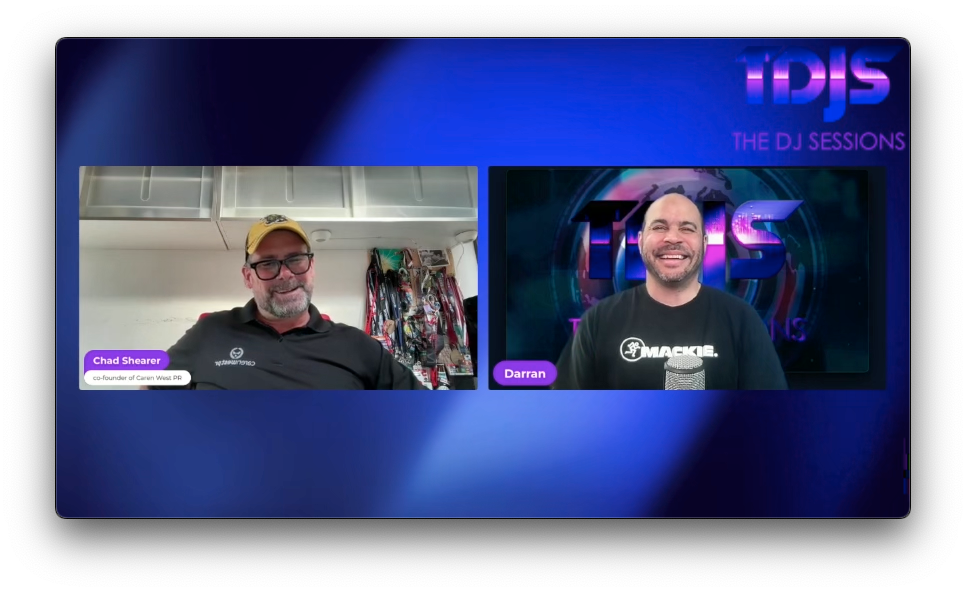
Chad Shearer – Music Festivals, PR Strategy, and Building Artist Visibility on the Virtual Sessions 3/10/26
Shownotes
Coming in from Atlanta, Georgia Chad Shearer joins the conversation to discuss the evolving role of public relations in electronic music and large scale festival culture. As a partner at Caren West PR, Chad oversees the firm’s music festival division and works with events across the United States, helping shape how festivals, artists, and brands communicate their stories to audiences and media outlets.
Chad explains how festival publicity has evolved beyond traditional press coverage into a broader ecosystem that includes digital media strategy, influencer engagement, and year round storytelling. Successful festivals now operate like full media brands, building anticipation months in advance through coordinated campaigns that combine artist announcements, visual identity, social content, and partnerships with key publications.
The conversation explores how artists can better position themselves within festival lineups by understanding the PR pipeline behind major events. Chad breaks down the relationship between booking teams, marketing departments, and publicity teams, explaining how timing, narrative, and audience alignment influence which artists gain momentum in a crowded field.
He also reflects on the long term value of authentic storytelling in music promotion. Whether working with emerging artists or globally recognized festivals, strong narratives help audiences connect with the people and culture behind the music. In an industry driven by constant releases and nonstop content, meaningful storytelling remains one of the most powerful tools for building lasting artist careers.
Topics
0:08 – Introduction and Chad Shearer’s role at Caren West PR
3:12 – How music festival PR has evolved over the years
7:46 – Building anticipation through festival announcement strategies
11:20 – The relationship between booking, marketing, and publicity teams
16:02 – How artists gain visibility within major festival campaigns
21:30 – The role of digital media and influencer partnerships
26:18 – Why storytelling matters in modern music promotion
31:42 – Working with festivals across multiple markets and states
36:55 – How emerging artists can attract PR attention
42:10 – The future of festival promotion and audience engagement
Connect with Chad Shearer
Caren West PR: carenwestpr.com
Instagram: instagram.com/carenwestpr
About Chad Shearer –
Entering its 20th year, Caren West PR is an award-winning, full-service public relations firm specializing in lifestyle, entertainment, and events. From music and fashion to food and events, we work with forward-thinking companies, artists, events, and brands. We are a team of multi-talented insiders, facilitators, and influencers ingrained in the entertainment community and defined by drive, vision, and experience. We believe in the power of being connected, good old-fashioned hard work, and providing our clients with innovative and strategic PR, social media, and design solutions backed by research, expertise, and our passion for delivering meaningful results.
The firm was co-founded by Caren West and Chad Shearer. Shearer is in charge of CWPR’s music festival vertical, with events throughout the country, across 10+ states.
Over the last twenty years, Chad David Shearer has developed Caren West PR into a regular fixture on the national music festival scene, which ably complements its lifestyle and entertainment public relations division.
In addition to serving as the firm’s co-founder and Creative Director, Shearer has served as the PR project leader for many of CWPR’s music-based clients, including; Relentless Beats, Imagine Music Festival, the Frye Company, Bass Camp Festival, Highball, Lost Art Music Festival, Revs & Riffs Music Festival, Big Night Out, Phoenix Lights Festival, Goldrush Music Festival, Decadence, DUSK music festival, Seismic Dance Event, Camp Bisco, Project Pabst, Gem & Jam, CRUSH, BOO!, Mad Decent Block Party, Wildwood Revival, Euphoria Music Festival, Global Dance Festival, TomorrowWorld, Nine Dot Cannabis Beverages, the Georgia Hemp Co., Wild Heaven Craft Beers, and more.
https://www.instagram.com/carenwestpr/
https://www.facebook.com/carenwestpr/
https://www.linkedin.com/company/caren-west-pr
About The DJ Sessions –
“The DJ Sessions” is a Twitch/Mixcloud “Featured Partner” live streaming/podcast series featuring electronic music DJ’s/Producers via live mixes/interviews and streamed/distributed to a global audience. TheDJSessions.com
The series constantly places in the “Top Ten” on Twitch Music and the “Top Five” in the “Electronic Music”, “DJ”, “Dance Music” categories. TDJS is rated in the Top 0.11% of live streaming shows on Twitch out of millions of live streamers.
“The DJ Sessions” is listed in the Feedspot directory as one of the Top 60 EDM Podcasts. The series has also been covered by Magnetic Magazine, MI4L, EDMTunes, Fame Magazine, and more.
It has also been recognized by Apple twice as a “New and Noteworthy” podcast and featured three times in the Apple Music Store video podcast section. UStream and Livestream have also listed the series as a “Featured” stream on their platforms since its inception.
The series is also streamed live to multiple other platforms and hosted on several podcast sites. It has a combined live streaming/podcast audience is over 125,000 viewers per week.
With over 2,700 episodes produced over the last 16 years “The DJ Sessions” has featured international artists such as: Matt Staffanina, Cosmic Gate, The Midnight, Amal Nemer, Andrea Casta, Peter Mac, Martin Jensen, Felix Sama, Larse, Ria Mehta, Jens Lissat, Riko & Gugga, BT, Martin Eyerer, Thomas Turner, Plastik Funk, Johan Blende, syence, Redman, Youngr, Dr. Fresch, Sergio Matina, Remo Giugni, Andrew Mills, Robbo Fitzgibbons, HAXHIA, Jungstedt, Deuandra, Faranoe Bros., Leandro Da Silva, Djuma Soundsystem, Massimo Vivona, Late Aster, Andrea Grasselli, ASTOR, Ferry Corsten, Nvrsoft, Alejandro, Thaylo, Robert Owens, Darude, Erika Grapes, Herbert Holler, Meecah, YORK, Sevenn, Amber D, Joey Riot, Drove, Martin Trevy, Thomas Datt, Siryuz & Smoky, Simon Shackleton, SurfingDJ’s, Jacob Henry, Rïa Mehta, Vintage & Morrelli, Joachim Garraud, Mizeyesis, Drop Out Orchestra, Dave Lambert, Tom Wax, Kenn Colt, Nathassia aka Goddess is a DJ, Joni Ljungqvist, mAdcAt, Wuki, DiscoKitty, Handshake in Space, Thaylo, Moon Beats, Barnacle Boi, IAMDRAKE, Spag Heddy, Scott Slyter, Simply City, Rob Gee, Micke, Jerry Davila, SpeakerHoney, Sickotoy, Teenage Mutants, DJ Mowgli, Wooli, Somna, Gamuel Sori, Curbi, Alex Whalen, Netsky, Rich DietZ, Stylust, Bexxie, Chuwe, Proff, Muzz, Raphaelle, Boris, MJ Cole, Flipside, Ross Harper, DJ S.K.T., Skeeter, Bissen, 2SOON, Kayzo, Sabat, Katie Chonacas, DJ Fabio, Homemade, Hollaphonic, Lady Waks, Dr. Ushuu, Arty/Alpha 9, Miri Ben-Ari, DJ Ruby, DJ Colette, Textbook Maneuver, Nima Gorji, Kaspar Tasane, Queen City Hooligan, Andy Caldwell, Party Shirt, Plastik Funk, ENDO, John Tejada, Hoss, Alejandro, DJ Sash U, Arkley, Bee Bee, Cozmic Cat, Superstar DJ Keoki, Crystal Waters, Swedish Egil, Dezarate, Maddy O’Neal, Sonic Union, Lea Luna, Belle Humble, Marc Marzenit, Ricky Disco, AthenaLuv, Maximillian, Saeed Younan, Inkfish, Kidd Mike, Magitman, Michael Anthony, They Kiss, Downupright, Harry “the Bigdog” Jamison, DJ Tiger, DJ Aleksandra, 22Bullets, Carlo Astuti, Mr Jammer, Kevin Krissen, Amir Sharara, Coke Beats, Danny Darko, DJ Platurn, Tyler Stone, Chris Coco, Purple Fly, Slantooth, Amber Long, Robot Koch, Dan Marciano, Robert Babicz, KHAG3, Elohim, Hausman, Jaxx & Vega, Yves V, Ayokay, The Space Brothers, Jarod Glawe, Lotus, Beard-o-Bees, Luke the Knife, Alex Bau, Arroyo Low, Camo & Crooked, ANG, Amon Tobin, Voicians, Florian Kruse, Dave Summit, Bingo Players, MiMOSA, Drasen, Yves LaRock, Ray Okpara, Lindsey Stirling, Mako, Distinct, Still Life, Saint Kidyaki, Brothers, Heiko Laux, Retroid, Piem, Tocadisco, Nakadia, Protoculture, Sebastian Bronk, Toronto is Broken, Teddy Cream, Simon Patterson, Morgan Page, Jes, Cut Chemist, The Him, Judge Jules, DubFX, Thievery Corporation, SNBRN, Bjorn Akesson, Alchimyst, Sander Van Dorn, Rudosa, Hollaphonic, DJs From Mars, GAWP, David Morales, Roxanne, JB & Scooba, Spektral, Kissy Sell Out, Massimo Vivona, Moullinex, Futuristic Polar Bears, ManyFew, Joe Stone, Reboot, Truncate, Scotty Boy, Doctor Nieman, Jody Wisternoff, Thousand Fingers, Benny Bennasi, Dance Loud, Christopher Lawrence, Oliver Twizt, Ricardo Torres, Patricia Baloge, Alex Harrington, 4 Strings, Sunshine Jones, Elite Force, Revolvr, Kenneth Thomas, Paul Oakenfold, George Acosta, Reid Speed, TyDi, Donald Glaude, Jimbo, Ricardo Torres, Hotel Garuda, Bryn Liedl, Rodg, Kems, Mr. Sam, Steve Aoki, Funtcase, Dirtyloud, Marco Bailey, Dirtmonkey, The Crystal Method, Beltek, Darin Epsilon, Kyau & Albert, Kutski, Vaski, Moguai, Blackliquid, Sunny Lax, Matt Darey, and many more.
In addition to featuring international artists TDJS focuses on local talent based on the US West Coast. Hundreds of local DJ’s have been featured on the show along with top industry professionals.
We have recently launched v3.4 our website that now features our current live streams/past episodes in a much more user-friendly mobile/social environment. We have now added an “Music” section, internet station, show notes, transcoding, captions, and translation into over 100 languages, There is also an updated mobile app (Apple/Android) and VR Nightclub (Beta in VR Chat).
Transcript
[Darran]
Hey everyone, welcome back to another episode of the DJ Sessions Presents the Virtual Sessions. I’m your host, Darran. And right now I’m sitting in the virtual studios in Seattle, Washington, and coming in all the way from, I’m hoping you’re in Atlanta, Georgia, because that’s where you’re based out of.
We have Chad Shearer with Caren West PR. Chad, how’s it going today?
[Chad Shearer]
It’s going fantastic.
[Darran]
Awesome, well you are definitely one of the most busiest guys that I know in the business, running around all the time, event after event. We were doing a little pre-show talk about that, but you didn’t just start in this business like yesterday. You’ve been doing this for a while now, and Caren West is entering its 20th year.
Congratulations on that. When you look back to the early days, what was the original vision for the company and how has that vision evolved as the music and festival world has changed?
[Chad Shearer]
Okay, well, I mean, the company itself is drastically different because I came to the table as a graphic designer and creative director, and my business partner, Caren, the company’s namesake, she was this PR guru, she was on radio, she had columns in magazines and newspapers, and we were kind of trying to do the whole peanut butter and chocolate type thing and see if we can come up with some magic and kind of shorten the distance between a graphic designer’s ego and a publicist’s ego. That worked pretty well for a while, and we actually still offer design services on a much more limited basis, but the PR started to get bigger and bigger, which kind of pulled me into jumping in with both feet and trying to learn how to do it 20 years ago, which I’d like to think I’m personable.
PR is a relationship game, so I’d quickly develop my relationships, and the music thing happened, Caren, before our company came together, she had her own thing going on, and she had done the PR for a thing called Music Midtown, which doesn’t exist now. At the time, it was about 300,000 people in 11 stages, very multi-genre festival. When people started knocking and wanting to bring back some of these festivals to the Atlanta area, she was a little hesitant to get back into it, and I wanted to, I’m very passionate about music, I love all kinds, and I wanted to get in and do it, so I wanna say the first one I did was maybe Echo Project, it only lasted a year here in Atlanta, not my fault, but then it quickly jumped, from Camp Biscoe up in New York to Counterpoint back here in Atlanta, I don’t imagine, and probably my biggest market right now is with Relentless Beats in Phoenix, and it’s definitely, it’s night and day from what it was, I mean, even the festivals themselves, just going to a festival, if you’ve gone to a festival for any period of time, like over a course of years, they’ve changed, I mean, even on, like a quick post on DJ Lovers Club or whatever about what the stages looked for EDC year one compared to what they look now, it’s more of a, it’s not just about the music anymore, it’s an experience.
[Darran]
Absolutely, and you helped Caren West build that into a major presence in the national festival circuit, what do you think separates successful music festival PR from standard event promotion?
[Chad Shearer]
I should have prepared for this. You know, it’s tricky, a lot of people, you’re gonna think you can just toss together a release or some calculated social posts and have success there, and those are two very big parts of it, but besides just a release that’s kind of, I’m giving you the story that you can post on your site or whatnot, there’s bigger stories, the things that we do, like with East Meets West, I mean, that’s a company that’s grown faster than probably anybody really anticipated, and yet they’ve got all these events that are coming at a fast rate, you have to tell the story, how did that come about?
It didn’t come about just because you wanted to toss Chris Lake on a stage out on a pier in Brooklyn, they really put some thought into that and partnered with the right people, and that story will go untold unless you push a little further, and I think that that’s ultimately what good PR does, it’s tough though, do I automatically necessarily, me and my team have the time to come up with 100 original stories for every event that we do, that would be like around the clock type thing, so you have to pick and choose, you have to hopefully get to partner with some good media people that want to, that have their own ideas to tell stories, so we capitalize on that and try to work, I really like when someone comes to me with a story.
[Darran]
And I can relate to that as even being, starting out as a small living room podcaster to building it up and working with international names and brands and things like that, even now looking, I was telling you a little free show, we’re looking at opening up our own event space here in Seattle, and I have some media contacts that I’ve built really good relationships with that will say, okay, just send us your PR, get us in, we’ll get your story, we’ll get you something written up at a local level, but I’ve hired two people in the past to help me out with PR and contacts, and I’ll tell you, that has been probably one of the best ad, I wouldn’t say ad spends, but one of the best spends I’ve ever done, because they have that know-how, they have that contact database, and people have already listened to them or they’ve already built those relationships. If you try to do it all on your own as a nobody, it can be a lot harder.
[Chad Shearer]
I mean, it definitely, I would agree on that, just because sometimes people don’t wanna hear how great or what you’re doing that’s great from you, they want somebody else to be like, okay, let me tell you what Thomas Turner’s doing. Thomas doesn’t have to be the one that’s being, you know, bragging about himself or whatnot, he would have plenty to say, the company’s older than our company, so yeah, it helps to have someone that’s going to bat for you.
[Darran]
Mm-hmm, definitely. And you work across music, lifestyle, entertainment, I saw food in there on the website today, wow, those pictures look great, and events. How does working across multiple industries strengthen the way you approach PR campaigns for, say, music clients, Indra?
[Chad Shearer]
Well, that’s a good question. For us, it was more, we didn’t wanna be just the restaurant and PR company or just the music festival, PR company, or art galleries, or whatever. For the most part, we did it, I would say almost selfishly, to get us, you know, keep us engaged, you know, so we, you know, aren’t bored with what we’re doing, we were, it helps create excitement.
And it’s that excitement that, you know, I think will transfer over to, you know, coming up with different story ideas, as I said, you know, earlier, what we need, and, you know, kind of interesting, I do a lot of media operations at our events, so a lot of times you’ll catch me with my radio and wristband or whatever, running around like I got my head cut off. People that don’t go to them as much as I do, a lot of my team comes up with some really good ideas, you know, through reading different stories in media, or, you know, when we did, when we worked with Tomorrow World, you know, partnering with some culinary people, so we’re bringing in, you know, Chef Gillespie or whatnot, and we’re building out a bar for him, which is a VIP experience. And we’re able to tell that story, so that, you know, for a while, a lot of people, because the majority of the work I do is, I would say in the EDM world, people will be like, well, I’m not really into it, or that, you know, I don’t cover that, or whatever it would be.
And this, having these things where you cross culinary, or we’ve got a cannabis village at some of our festivals, it allows us to tell different stories. And like I was saying earlier, this is more of, more than just the music, it’s definitely an experience. And having this thing where, you know, we work with Jitter Joe’s Coffee, and we’re allowed to, you know, let’s bring in coffee, so we’ll give it to camping festival, while we set up a cafe, you know, serve coffee after we do yoga class, or whatever it would be.
It gives us an opportunity to stretch our legs and tell stories that isn’t just about, you know, here’s John Summit, or Diplo, or whatnot, but they’re obviously great, great stories in themselves. And you see Diplo doing his run club and all that. It’s having that multidisciplinary, you know, PR background that allows us to do, to tell clients stories that are bigger than what they may be initially set out to achieve.
[Darran]
And you mentioned earlier, obviously working with Relentless Beats to imagine festival, Gold Rush, Dusk, Seismic Dance Event. You’ve represented a wide range of events. What do the best festival brands have in common from a PR and audience building perspective?
[Chad Shearer]
I think from a PR standpoint, it’s always the best festivals are the ones where they invite you to the table to have the conversation. Often, you know, and it’s sometimes it’s not, I’m not criticizing any of my clients past or present, but sometimes we’re moving at such a rate with so many events coming down the tunnel. I’m finding out things, maybe a little bit after the point I should have found them out or would have been helpful to have it.
But, you know, when you’re invited into the table, you can talk a little bit more strategy. That definitely helps. And that’s something I love.
I think that a company like Relentless Beats does an amazing job in building its audience through social media. I don’t know if you can see the gray in my beard. I’m not a big fan of social media.
I have people that do that for me. They’re much better and more patient and more talented. But they, you know, they seem to do it so that, you know, you want to create long after the stages are down, you want to have that conversation continue on, you know, with Decadence probably being Relentless.
Yeah, definitely our biggest event of the year. People get into January and we want them still being excited about what just happened a couple of weeks before that, you know, and we want to build that excitement for when the aftermovie comes out in, say, March or April. And then we want to tease, you know, dates and, you know, whatever it will be and lineups.
You know, for that conversation, Relentless does a really great job of that and probably some of the best I’ve seen.
[Darran]
Yeah, and you mentioned social media just a few moments ago. In a world where artists and festivals can post directly to fans on social media, what is the role of the PR firm today when it comes out? You said you don’t like doing the social media, but why does strong public relations still matter?
I’m not sure we really covered that, but basically, you know, back in the day, if you wanted to get out the press, you hired somebody. Now you’ve got a social media page and go boom and hashtag and it jumps out there and bump it up the ticks and the instas and the loose guys and the Jesus.
[Chad Shearer]
I think it’s more about being genuine. Social media does, you know, it gets the message out there probably faster than I can do it because I have to rely on somebody that I pitched to be able to read that email, take that story or take my phone call, post that story. So that’s never going to post like it, but in real time.
And I’ve got Dylan and his team doing it. I think we still exist because PR is more than just about getting press. It’s more than about making the noise.
It’s reputation building. It’s a lot of crisis control on that type of thing. And, you know, with social media, the thing that makes me laugh is it’s just that the phrase haters are going to hate.
So sometimes that social media thing does go out first and people are like, well, they had to pause for a year. They had to cancel this or whatnot. I don’t believe they’re coming back or whatnot.
So we have to continue to keep telling that storyline and pulling it through, you know, because it can, those haters are going to hate and go viral in like two minutes. And the next thing you know, I’m hearing, getting a call. Should we take a post down or whatnot?
You know, I never really recommend, but it’s just the climate right now.
[Darran]
Yeah. No, I mean, I was a few months back. I was, I wouldn’t say necessarily call myself a victim, but a very prominent artist had come onto my Facebook wall.
I post something. Sometimes I vague book a lot because I have a lot of competition out there. As I learned in 2020, when Pandy hit and every electronic music artist, you know, everyone jumped online.
You were pretty much, if you weren’t doing a pod, if you weren’t doing a live stream, you were doing a podcast or you’re talking about how to do a podcast. And here I come along after doing this show for 10 years. And I noticed that I was giving a lot of advice out to people of years and years of wisdom.
Cause I didn’t just start in live streaming and podcasting. I’ve been doing public access back in 92. So I had a video camera in my hand for a while, but you know, all that fun stuff.
I’ve just given all the advice away. And so I realized I had to start not posting so much or being open about my posts because my competition, my direct competition, my friends that were now being my competition were seeing what I was up to. And I didn’t want to give that to them.
So I put a vague book post out there and a very prominent artist comes online and just says, why do you got to post like this? I don’t get it. Like publicly says that.
Not like in a back end message. And I just went, I just went off. I was like, look, dude, first of all, it’s my Facebook wall.
Second of all, if you don’t like something, you don’t have to comment on it. Third of all, you’re a very prominent artist in the electronic music world. And you coming in and slamming somebody who actually held this person in high regard until they did this incident was like, dude.
And I had people coming back in the thread going, why was that guy being such a jerk to you? And I’m like, yeah, I go, I didn’t do it. I didn’t do anything.
I didn’t say anything to him. I didn’t do anything to him. And so it was just like, yeah.
So I left it up there for people to still see. I didn’t take it down, you know? And I grilled him.
I remember writing what I would almost say a mini thesis. Just like, here’s my stance. And if you don’t like, just unfriend me, dude.
You know, leave me alone. But those things can turn into that heated rivalry or that flame war. And then the fans jump on board.
They share it over here to try to sandbag or cancel culture, whatever it is they want to do nowadays. But I think that’s where you do. If you have a strong directive with PR, which is where your team would come in and say, this is what we’re going to do.
It’s a three month, six month, nine month, 12, one year camp. This is what we’re going to build. Is that more the approach that you take as opposed to just doing like a one-off?
Like, here you go. For like, you’re doing like a festival campaign? Festival campaign.
Or yeah, if you were to take on a client and say, hey, what is your strategy here? You know, where do you want to, we’re going to start here. Where do you want to be at the end of the day?
[Chad Shearer]
Right. I mean, you really want, ideally you want about six months to get that whole thing started, you know? And so there’s so much that you have to consider.
And it’s definitely, you would create a loose strategy. But there’s times, you know, it’s like, okay, the line art isn’t getting approved because this artist wants to be up here. This artist wants to be up here.
It’s a different logo, a new logo, old logo. We’re, you know, radius clauses, all that type of stuff. So you kind of have to go with the flow.
But it’s, when you know something is coming at the end of the day, probably I only need maybe a week or a couple days because I can embargo stuff and tease it and, you know, reach out to Billboard or whoever it would be. EDM.com, like, hey, this is coming. What are we looking at?
You know, but we’re also, you’re also, like, I’m working with marketing teams that, okay, well, we’re going to go and actually go directly to these outlets and, you know, so that they can post. I’m in charge of the stores. They would be like, I’m going to have them post on EDM.com or EDManiac or whatever. He’s going to post on, you know, Instagram at 1 p.m. Central or whatever. So it’s, it’s important that marketing and PR is talking together.
[Darran]
Yeah, totally. Well, in my wheelhouse, I’m pretty much in both of those. But, you know, just recently sending out some press releases.
You know, we were in EDM, EDManiac, EDMtunes and saw the bump in growth when they pushed the stories out there, which was really awesome. Because it’s kind of, you see the money working. That makes sense.
[Chad Shearer]
They’re great outlets and they’ve come a long way. You know, some of the core ones are still there from when I was started doing this. I think the first festival I did was maybe 2007.
So some of the core ones are still here. They look a little different. They’re much, much bigger, but they’re, you know, it’s really cool to see them kind of be captains of industry.
[Darran]
And, you know, when you first take on a new music festival or event client, I mean, are you looking for new music festivals and events right now? Are you always like, is the door open?
[Chad Shearer]
Is the plate full? And I always have, my ears are always open. I’m at this point, I no longer actively go after anything.
A lot of it’s presented to me, you know, with Relentless alone. To be honest with you, when they, when we first started together about 12 years ago, that was, it was pretty much at that point, just the Valley with Phoenix and Tempe and all that, you know, maybe a little bit of Albuquerque. But then, you know, we started growing and bigger, you know, there’s stuff that they’ve partnered with and done in Hawaii and Texas and whatnot.
That’s kind of, that’s been my primary. I mean, we knew we also have an offshoot called Moonlit Nights and they’ll be doing something during Biker Week in Arizona. Where Puck Cherry and a bunch of other bands are coming out.
And that’s totally different than their normal dance pair. So they’ve been, we’ve done country events. So for the most part, I’ve been content with what I have.
You know, there’s been a few that have gone away, that have gone, gone away. Like they don’t even exist anymore that I wish were still around. And there’s been opportunities where it just wasn’t a fit for them or for me.
And I remain a fan from afar. And like, Seismic’s a great example of that. I think what they’re doing, what Telegrae is doing and with the Concourse Club and everything.
They’re really, yeah, I cheer from afar.
[Darran]
And I was going to relate, go into this is, you mentioned going back 12 years working with Lendless and all that fun stuff. When you first take on a new music festival or event client, if you do, what are the first things you look at to determine how to position that brand in a crowded market?
[Chad Shearer]
Oh, that’s a good question. I really want to see something, what I look for mostly is I want to see something unique. What is the story we’re trying to tell?
You know, a lot of the, for a while, and this is maybe like five or six years ago, a lot of festivals, almost every single one of the festivals, the artwork looked the same. It was like the woman and everything’s lined up and neons and all the, it was just getting a little tired so that, you know, it was hard to differentiate. So what is the experience?
Imagine, you know, they had the whole aquatic thing. So that was something we were, I was leaning, you know, hard into for that. It’s the lineups as well.
We’re getting a little homogenized where the same lineup is the same people, you know, from city to city too. So I was booking interviews and, you know, is that interview I was booking for this one or is it this one? What week is it?
Who am I credentialing? So it got a little convoluted. So when there is an experience, like Gold Rush is a perfect example.
That’s, you know, especially this year, finally, when we went back to Rawhide and we’re in the Western town, it really brought it back to its roots. And that was kind of, you know, I didn’t even see a Western town outside of Little House on the Prairie or what I was on TV, let alone walk through one and, you know, putting the stages in there and, you know, doing other things that kind of engage people outside of the music. That’s what I typically like to look for.
[Darran]
But that is- You know, with so many festivals, you mentioned this a little early about getting the, not monotone, what was the word you used? Just the same flyer, same lineup. Wow.
With so many festivals, you know, competing for attention, ticket sales, sponsors, media coverage, what are the biggest mistakes that you see festivals make when trying to market themselves or in PR?
[Chad Shearer]
Oh, man, that’s a tough question. Because if I’m not directly in line with it, I don’t necessarily know if they’re making a mistake. What you normally see is, if you see mistakes, it’s too late already.
You know, it’s, okay, well, we’re two months out and we’ve only announced the first round up lineups. That’s bad, you know, or, you know, they keep slashing the ticket sales or doing deals after people that were your biggest supporters have already put the money in and all that on their early adopter, you know, early access or pre-sale. Those who probably, you’re like, oh, that one might be in trouble.
You might see it cancel or whatnot. But yeah, it’s hard to, it’s really hard to say. With the ones that I’m working on right now, they all seem to be really rock solid.
I don’t see any, you know, they’re just great, fun concepts. I mean, we have a Why Not Now that just pre-sale today. That’s gonna be an industry city in Brooklyn.
And that’s a really cool new area. Well, repurpose areas between these two industrial type buildings. But I mean, the stages between the two buildings, there’s VIPs, they’ll be up in some, they’re gonna utilize some of the building itself so they can create a VIP experience.
I’ve not done, yet done a walkthrough, so that’s about the extent of what I know is the pictures I’ve seen. But it sounds just like a really cool, you know, experience. I think people are gonna like it.
If you don’t wanna go both days, you don’t have to, because if you’re not, one day is more like UK garage, other day’s more house. Or you can go both days because it’s probably gonna be a fantastic trip. And it’s New York City in the summer.
Well, just about, it’s Memorial Day weekend. So it’s gonna be good weather. And yeah, I’m excited for that one.
[Darran]
And with social media being so prevalent out there, how do you balance hype with authenticity when promoting a music event or other types of events, especially at a time when audience are quick to call out anything that feels like forced or overly polished or not genuine?
[Chad Shearer]
Came up with some good questions. I’m definitely not prepared. Oh man, I don’t know.
We’ll have to come back to that one. Yeah, I don’t have an immediate answer. There’s times I see stuff and I’ll be like, that’s a huge, who cares?
There was a festival announced today and I’m not gonna name it, but it was announced today and there was like a monstrous lineup. And I was like, okay, I guess so. But it’s not really doing anything new, but I would like the lineup probably, I could probably sell a lot of, get a lot of hits from it.
But, you know.
[Darran]
That kind of, that response kind of lead that right into my next question though. You’ve worked with both emerging events and established names. What does a newer festival need to do to earn credibility with the media fans and industry partners?
Your best kind of short answer on that.
[Chad Shearer]
The, I would say the fastest way at your brand new festival, the fastest way is somehow get Daft Punk to come out of retirement. Skrillex on the other day. People are gonna wonder what the hell you did and where’d you get that budget?
Yeah, I mean, for a new festival, you gotta have some kind of a unique experience and then come up with a solid lineup or at least a few cornerstone artists that people wanna see. The back-to-backs are really that help a lot too. There’s a lot of people go for just those, alter ego sets or whatnot.
They really, it’s something different. It’s not the same.
[Darran]
Yeah, I mean, I’ve been going out to electronic music events since 92 and it kind of, in my own market, it kind of got to that same old, same old, same music, same people, same thing. And it wasn’t until I started traveling outside of the States, within the States and over to Europe for like ADE or going over to like Rave the Planet, which was just, I’d never been around 350,000 people on the back of a double-decker semi-bus, 25 of them driving around, taking number one in the world. And it was just an awesome, that’s what I have to decompress from 2024.
I just was like, I don’t know what to do next. I’m a live streaming show, but I just was like, this is awesome. And I don’t have the budget to keep this going and going and going as much as I want it to.
But it was awesome.
[Chad Shearer]
Yeah, it’s definitely- Look at the amount of artists out there, you know, whether, I know there’s a lot of people burgeoning and trying to break, but, you know, you got to give some grace because there is a limited amount of artists and some people do have their favorites. But I always wanted to do like, if we’re going to have multi-stages, let’s do one stage that’s just like either called Legends stage or whatever you want. And let’s book Moby, Crystal Method, Paul Wolfenfeld, that type of stuff and get some of the guys that started the scenes back in like the 90s, you know, and people want to go and check it.
It doesn’t have to be your main stage, but that’s something that to me is kind of cool. I mean, it’s the thing like Stranger Things that somehow Kate Bush has won the number one song, you know, a couple of years ago. Moby, I think just had a resurgence because of that.
It’s like, okay, cool. Let’s discover some old, new music.
[Darran]
Well, I mean, and with so much being thrown out there nowadays, I think it’s, I don’t want to, I think it’s 60,000 songs a day, maybe more than that, maybe a minute. It’s an insane amount that if I remember back when I started the DJ sessions, I was talking with the DJ and I said, how often, how many hours a week do you spend looking for music? And he goes, I spend sometimes three to four hours a day looking for tracks.
And I go, you can’t listen to the whole track spending three, four hours. You’re going through hundreds and hundreds and hundreds of songs to get this. So, you know, of course the barrier to entry as a DJ is obviously there was the vinyl world and then it came into the digital world, CDs and then obviously the flash drives.
And now they’re getting the units that are connecting directly to the internet. So you got people that can be like, you can play this request for me because you have the ability to download from Beatport right here. Sure.
I’ve had DJs on the show and they’re like, that’s a freaking nightmare for us. But that amount of consumption, I guess, or accessibility, you know, is it going to have a blowback? Like you said, let’s bring out the legends and bring back that essence that maybe people weren’t there in 92 or 97 or 2005, you know, and they’re like, wow, that was really badass.
You know, here’s a question for you though. As someone leading Caren West’s PR music festivals across more than 10 states, how do you tailor the PR strategies for different cities, regions, and audiences without losing any of your core identity of an event?
[Chad Shearer]
I mean, that’s basically to me, I might not be answering your question. So feel free to push it back. It’s just, I have different curated lists, you know, the one, I have a national list, but I also have one that’s specific just to the Valley or just to New York.
And New York actually has to break down even further to like, okay, Brooklyn. I need even more specific, you know, who’s such a monster in its size and scope. But yeah, I think it’s, I mean, for me that I have relationships.
I love to, another thing I like to do is I like to get in with a lot of, like it was easy to do in Arizona because of ASU and University of Arizona, get in with a lot of these student journalism programs. And then as they rise up and if they continue to go to shows or whatnot, and now they’re working for Rolling Stone or Billboard or whoever it’s, you know, and we’re building, I feel like I’m building fans for my client that’s gonna last for 10, 15 years as well.
[Darran]
You know, no, I mean, that’s definitely a strategy that our event space we’re opening up is right next door to a college, you know, and those kids are gonna want something to do. And it’s like, hey, we can walk across the block or we can go half mile, a mile down the city. And it’s like, just come over here.
We’ll give you a student ID discount. I mean, but we’re also, I’ve done that before with media programs and bringing on interns and stuff and work with their video departments to bring on, you know, actually putting out our intern call right now have a few coming on board. And I met her in the Superbowl and we did some crazy stuff with our truck here in Seattle.
But, you know, go into the student unions and go into the student newspapers. You know, I was in media services. I created the student media services department when I was going to community college so I can produce my own television show.
But yeah, it’s definitely a way to get in. I think you’re right is hit that younger base. It’s gonna grow and become the professionals later on.
You know, the biggest, what are the biggest changes you’ve seen in music media coverage though over the last 20 years? How has that changed the way you pitch stories and create campaigns? Obviously we didn’t have, well, I guess 2005 social media was there.
I had a MySpace account.
[Chad Shearer]
It was there, but right now it’s acceptable that you gave me a story on your Instagram to promote Phoenix Lights or whatever it will be. And I’m still old school. It’s not necessarily okay for me.
I need to, especially something that’s gonna disappear in a little bit. I don’t, so that’s changed a bit. I don’t know.
It’s what people place value on and I have to get past that. You know, my demo, I’m not my demo. Rarely, like maybe for the Buck Cherry show for Biker Weekend, I’m closer in age on the demo, but our demos, you know, we’re probably around 18 to 25, maybe a little bit older.
They’re not necessarily dialing up their laptop. They’re certainly not really reading print, but they’re doing social media and so we need to get the word out. So a win is a win and I’m fine with that as long as I’m still looked at as a value, you know?
[Darran]
Yeah, I can kind of relate to that. It’s like I’m going back and I’m taking a little couple of changes. We did a rebrand with our site recently, added some new stuff in there, but one of the things is we have over 2,700 plus episodes, but if somebody wanted to go through, now we can highlight the big names, but if they want to go through, they’d have to go all the way down, all the way, you know, like keep hitting a load more button and I’m going back and I’m going to go back and say, nope, these are the videos from this.
You can go back and click it by year and almost click it by month. So that way, you know, it’s easily so like, oh, I didn’t know you had X, Y, D, G, J back on in 2007. It’s like, yeah, you know, search our site a lot more user, make it a lot more user-friendly in that sense of things and you’re right, talking to those kids.
I mean, I’ve gotten down the TikTok rabbit hole before and then I go over to Timu and buy 25 things and I don’t know how Timu does it. They like read your mind or something. I need that for my cat.
I need that for my dog. Oh, I need a new toolkit. Okay, it’s only 10 bucks, you know, but yeah, the times have changed and one of the things we’re looking at doing and I’m sure you’ve heard this echo throughout the music industry as a whole is when you come to our event space, your cell phone will go into a bag and you just won’t be able to use your camera.
You can use your phone, text, talk, do whatever you need to do, but it’s in a bag and that way, we’re wanting to get people more engaged with our events and one of the other things is too, we’re basically a live closed studio as well. It’s also sending our stuff out there for pay-per-view. So, you know, we don’t want somebody misrepresenting our show or being on the dance floor.
[Chad Shearer]
Right, nothing ruins a good shot than seeing a hundred phones up.
[Darran]
Yeah, and we’ll have a photo booth or if you want to go outside and make a viral post, but our environment, we want that. We want to bring back that community back like it was when I was a kid going out. You know, the DJ was up in the corner.
You didn’t even know who they were, who was playing and the club was just dancing. You know, it was crazy and I’m glad we didn’t have cell phones back then.
[Chad Shearer]
Yeah, for many reasons.
[Darran]
Yeah, but, you know, for artists, promoters, festival founders watching this interview, what makes a brand actually media ready and what should they have in place before they hire a PR team?
[Chad Shearer]
The plan, I mean, the thing is when, and this goes probably a little bit more so for some of our other industries that we work in, when the machine is turned on, PR machine, it’s kind of hard to stop it. Especially if you’re like a new restaurant doing a grand opening, you really only have one time to make an impression. Music festival is a little different.
You know, everyone has their own, you’re looking at 10, 20, 30,000 people and you could have that many opinions on what they thought of the event. So there’s a little bit more leeway for second chances and obviously the lineup changes and it’s not a weekly or daily thing. And then as you get bigger, I mean, it’s working with people like Thomas Turner and Ryan making sure that they’re media trained and able to comfortably speak and not leak stuff that you don’t want leaked or you don’t want to go back to like 2007 and have somebody, you know, all of a sudden cancel one of our clients because they said something that might’ve been passable back then, but not passable now. So that’s a big part of it.
[Darran]
Yeah, I don’t know. I’m glad you brought that up because I love it when a guest leads right into my next question, that crisis communication is also a huge part of a live event, whether it’s weather, logistics, cancellations or audience concerns. How do you prepare clients to protect trust and reputation when things don’t go as planned?
[Chad Shearer]
I mean, it’s a multi-department scenario. So, you know, there’s the publicist that’s not necessarily gonna be the spokesperson unless there’s a lot of trust or we don’t want to have, we want to divert the attention onto the publicist and not to a principal. You know, you’re working with security, you’re working with weather department, you’re working with all these people to make sure that, you know, every single step, because at the end of the day, if our goal is to send everybody home at the end of the day, nice and safe and happy that they had a great time.
So, you know, we want, that takes a village to do that type of stuff. So my component in this, I’ve gotten very good at writing releases on the fly to communicate weather scenarios. Most of the stuff that most of the people that we need to communicate that to are already on site.
So we have that stuff that works with our security and other teams. And I’m, you know, I just, I put it out there. I feel that any questions and do what I think.
But yeah, it takes a village.
[Darran]
You know, unfortunately, a lot of the participants in these events, they don’t see the magic behind the scenes. They don’t see what goes on. Or the chaos.
What? Or the chaos, yeah. I mean, I was the video program manager for HempFest up here for two years, running four different stages.
And they wouldn’t give me a cart, but the part travels over the course of about half a mile. So I have to run to each stage, run around. And I’m the only one overseeing this whole project.
So I’d have to get there, listen, make sure audio is going like, okay, run to the next stage, run to the next stage, run. And, you know, maybe I could hop on a cart, but at the end of the day, you’re doing that for three days for 10 hours a day. And that’s just one event for a weekend.
[Chad Shearer]
I mean, yeah, right?
[Darran]
And there’s too many people to put rollerblades on or something to skate through and get through faster, you know, but, you know, it takes a lot. And there can be a lot of, I guess, I hope the term is right, unsung heroes that are really doing a lot of hard work.
[Chad Shearer]
There’s a lot of trust that’s been built along. That’s one of the things I love about working with Relentless is you develop that trust. There’s, you know, people that I have worked with for about a part of a decade, you know, same people, I see them in the same spots and know that you can rely on them.
There’s Rodney, there’s Mark, you know, Ryan’s coming around to carry, here comes Alicia. So it’s, they’re a fantastic team and they know what they’re doing. Nice.
[Darran]
And after two decades in the business, what excites you most right now about the future of festival culture, music marketing and the relationship between live experiences and brand storytelling?
[Chad Shearer]
Wow, that’s another good question. I don’t know what excites me. I always get excited when I see something new come about, you know, it’s, I think what’s happening up in New York with East Meets West presents, excites me because one of my favorite things that we’ve done here in Atlanta outside of the music realm is we work big on alternative venues.
And when that group is, whether it’s on the Brooklyn Army Terminal Pier or, you know, under an overpass or whatnot, it’s creating those, I like those alternative experience venues. Those are things that really kind of, I get excited about and makes me want to attend myself. You know, a lot of times when I’m attending, it’s for me, this is very much a business.
Maybe that’s why I’ve had such a long career is I don’t fanboy out at all. You know, that’s, a lot of times we’re doing interviews, we’re doing escorts, we don’t have the time to do that. You know, and as fun as Shaq is, it’s still business.
So we need that picture and we need to keep moving so Mr. O’Neill can do his thing. So, yeah, I don’t think I answered your question properly.
[Darran]
No, I think actually you did. I think you did. I can relate to the difference between being an attendee and having to work the show.
You know, it’s very hard for me to go to a show and be like, why am I not working the show?
[Chad Shearer]
I think, when I did, I think it was Chris Lake, it was the first time I was out on the pier, you know, and it’s June and the wind and breeze is nice and you can see, you know, downtown and midtown and you’re just out there doing your thing and people are ecstatic. They love it, you know. I don’t know if we can convince anyone to not bring their phone because there’s so much pictures or this stuff happening.
But yeah, that really kind of, I really appreciated that. But those types of things, more than just a field or another speedway or whatnot, which they serve their purposes, obviously, kind of get me to the point where I just want to go as a fan. Nice.
[Darran]
Well, you know, I know you’re a busy guy. We’re going to let you get wrapped up here. A couple more things.
Is there anything else you want to let our DJ Sessions fans know about before we let you go?
[Chad Shearer]
Oh my gosh. I feel like I’m always telling everybody what to do and, you know, what to write. So I would just say, probably keep out, look out for an email from me because I’m probably going to pitch you something pretty soon.
That’s about it.
[Darran]
I get them all the time and they’re beautiful. And I’m going to start responding to a lot more.
[Chad Shearer]
Hangout Now is the latest and greatest.
[Darran]
I’m looking at that right now.
[Chad Shearer]
That’s a tour that’s going everywhere. They’re stopping in Phoenix for us, which is nice. It should be fun.
Awesome.
[Darran]
And where’s the best place people can go to find out more information about you and everything your company at Caren West that you do there, your team?
[Chad Shearer]
I would say our website’s pretty good at doing that. That would be Caren West PR and there it is on the screen. Caren with a C, which we like to clarify every time.
And then all our social media is at Caren West PR. Awesome.
[Darran]
Awesome. Well, Chad, thank you again for being on the show. I know it’s been a long time.
We’ve been working on it and I will be seeing you in person multiple times this year at some events, probably starting down in the Southwest and then going to the East Coast type stuff. But again, thank you so much for being on the show today. It was a pleasure having you.
Thank you. You’re welcome. On that note, don’t forget to go to our website, thedjsessions.com, right there, use that QR code. Find out over 2,700 past episodes, 700 news stories published a month, our new music section, our syndicated live section and more at thedjsessions.com. All of our socials are right there as well. I’m your host, Darran, and that’s Chad coming in from Atlanta, Georgia for The DJ Sessions.
And remember, on The DJ Sessions, the music never stops.
Latest Shows
Latest News


