Arturia Pigments 7: The Best Gets Even Better
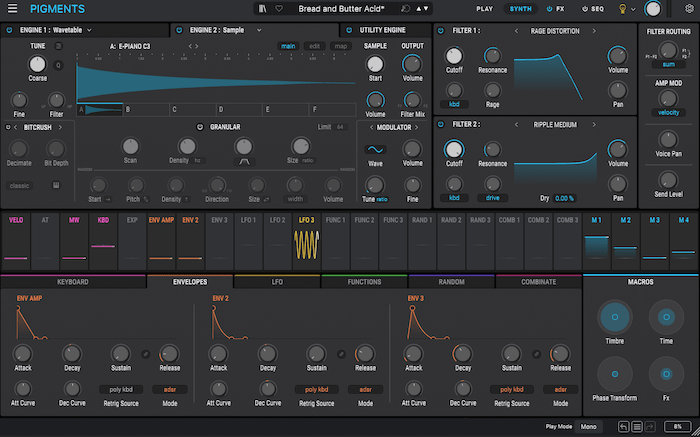

Pigments 7 is the latest version of Arturia’s incredible soft synth. Is now the time to finally take the plunge? Despite no new sound engines, the answer is yes. Here’s why.
In 2019, Arturia dropped Pigments, their first real non-emulated soft synth. Taking the ethos of more is better, Arturia have continued to update it with new sound engines, effects and features, adding more colors (as it were) to the sound palette.
We last checked in with Pigments at version 3, calling it a “one-stop synthesizer solution” and awarding it 4 1/2 stars out of 5. We’re now up to Pigments 7. The instrument already has virtual analog, wavetables, sample playback and physical modeling engines, plus more filters and effects than most people could even know what to do with. What more can Arturia possibly add? Unfortunately, there is no new sound engine, but what we do get with this update is a handful of new filters, an additional distortion effect, a revamped Play Mode, and some nice brush ups like snappier envelopes and better CPU usage.
The update is free, so no complaints for previous users. Is this latest package enough to tempt those who have yet to hand over their credit card number?
The Three R’s: Rage, Ripple and Reverb 
In the absence of a new synthesis engine (the latest was the beautiful physical modeling-powered Modal in Pigments 5), the biggest selling point—at least in terms of sound design—is the three new filters. Coincidentally, they all start with the letter R: Rage Filter, Ripple Filter and Reverb Filter. Each member of the trio is unique in its own way, as well as creatively surprising.
Unlike your bog-standard analog-style filters, which Pigments already has loads of thanks to its many classic synthesizer emulations, these new ones take things beyond what you may expect from something originally designed to subtract frequencies. The Rage Filter, for example, injects distortion into the filter circuit by overloading the feedback path with one of five different modes. This behaves polyphonically too, giving each note its own harmonic saturation. The Reverb Filter is what it sounds like: reverb used as a filter. Think of it as a way to color rather than just shelve frequencies. Finally, there’s Ripple, which combines multiple all-pass filters to create ringing, zappy sounds. None of these is likely to become your new go-to for basic shaping, but for radical sound design, they’re handy to have.
Additionally, Arturia have added an FM section to the Classic Filter, with both sound engines and their modulators as possible sources for frequency modulation.
Sing This Corroder To Me 
Pigments is already bursting with effects, but number 7 adds one more: Corroder. If the name didn’t already give it away, this is a distortion effect. And while the software has long had an effect called just Distortion, Corroder does things a little differently. Rather than lop off the top of your signal, it modulates it with an LFO, an incoming sound source, or another element in the synth, creating everything from amplitude modulation-like effects to unpredictable filth. Again, as with the new filters, it’s not an everyday effect, but certainly an interesting sound shaper that lies somewhere between distortion and modulation.
Revamps and Resnaps 
In terms of sound design, that’s the bulk of the new in Pigments. You do, however, also get a revamped Play Mode with animations that pulse and move in time to the played notes. How useful this is for you will depend on your tolerance for these kinds of things. We found it distracting; thankfully, you can turn animations off if you like.
More broadly appreciated are the new, snappier envelopes, which sound great on bass, plucks and lead patches. There are also CPU improvements (always a bonus with an instrument as complex as Pigments) plus new audio content including additional wavetables, samples, noises and presets.
Sound Design: Corroded Filters 
How do the new features sound in context? Let’s try them out with this bassline generated in Pigments 7’s sequencer.
We start with this bass sound. It’s derived from the Bass Ventura preset with a couple of extra tweaks. You can really hear those snappy new envelopes in action.
Snappy bass:
Next, we change Filter 1 to Ripple in Hard mode. As it sweeps through the cutoff, you can hear the multiple peaks ringing out. We’ve increased the resonance a little to make it more audible.
Peaking bass:
Next, we swap out the Reverb Filter for the Ripple. At certain points in the cutoff sweep you can hear it get smeared through the filtered reverb.
Reverbed bass:
Next comes the Rage Filter in Transistor mode. Rage adds additional saturation and color to the filter but in a different way than just cranking filter drive would.
Rage bass:
Lastly, we replace the EQ in the effects chain with the new distortion effect Corroder, with a saw wave modulating the signal. Sweeping the frequency alters the characteristics of the sound.
Corroded bass:
The Final Word
At this point, Pigments is less a synthesizer than a sound design playground. Sure, it has the Play Mode, which reduces the number of controls to the bare minimum needed for live performance, and if you like to take Main Stage with you on stage, then you’ll dig this immediately. But with all of the sound engines, filters, and effects (including the lovely new ones), Pigments is a synthesist’s dream. The fact that it sounds so damn good (and those new envelopes, come on, so punchy!) is all the more reason to fall in love.
If you haven’t fallen in love with Pigments yet, though, the handful of new features probably won’t be enough to turn your head. If you know it and love it, but have been waiting for an opportune moment to pull the trigger, this is it. Pigments always goes on sale when it gets an update, and that’s just as true right now. If you’ve been putting it off, this is the time to add to cart.
Even at full price, Pigments remains a great buy, and a strong contender for the best soft synthesizer on the market today.
[rating buy=”Arturia Pigments 3″ price=”$99 (price rising to $199 after January 7, 2026)” link=”https://www.arturia.com/products/software-instruments/pigments/overview” value=”5″ versatility=”5″ sound=”4.5″ ease_of_use=”4.5″ overall=”5″ text=”The best soft synth on the market is now even better. What are you waiting for?”] [social-links heading=”Follow Attack Magazine” facebook=”https://www.facebook.com/attackmag” twitter=”https://twitter.com/attackmag1″ instagram=”https://www.instagram.com/attackmag/” youtube=”https://www.youtube.com/user/attackmag” soundcloud=”https://soundcloud.com/attackmag” tiktok=”https://www.tiktok.com/@attackmagazine”] [product-collection]Read More
Latest Shows
Latest news
Gallery
-











Comments
This post currently has no comments.